
- By Nashtech PEB Team
- Sep 18, 2026
- 0 Views
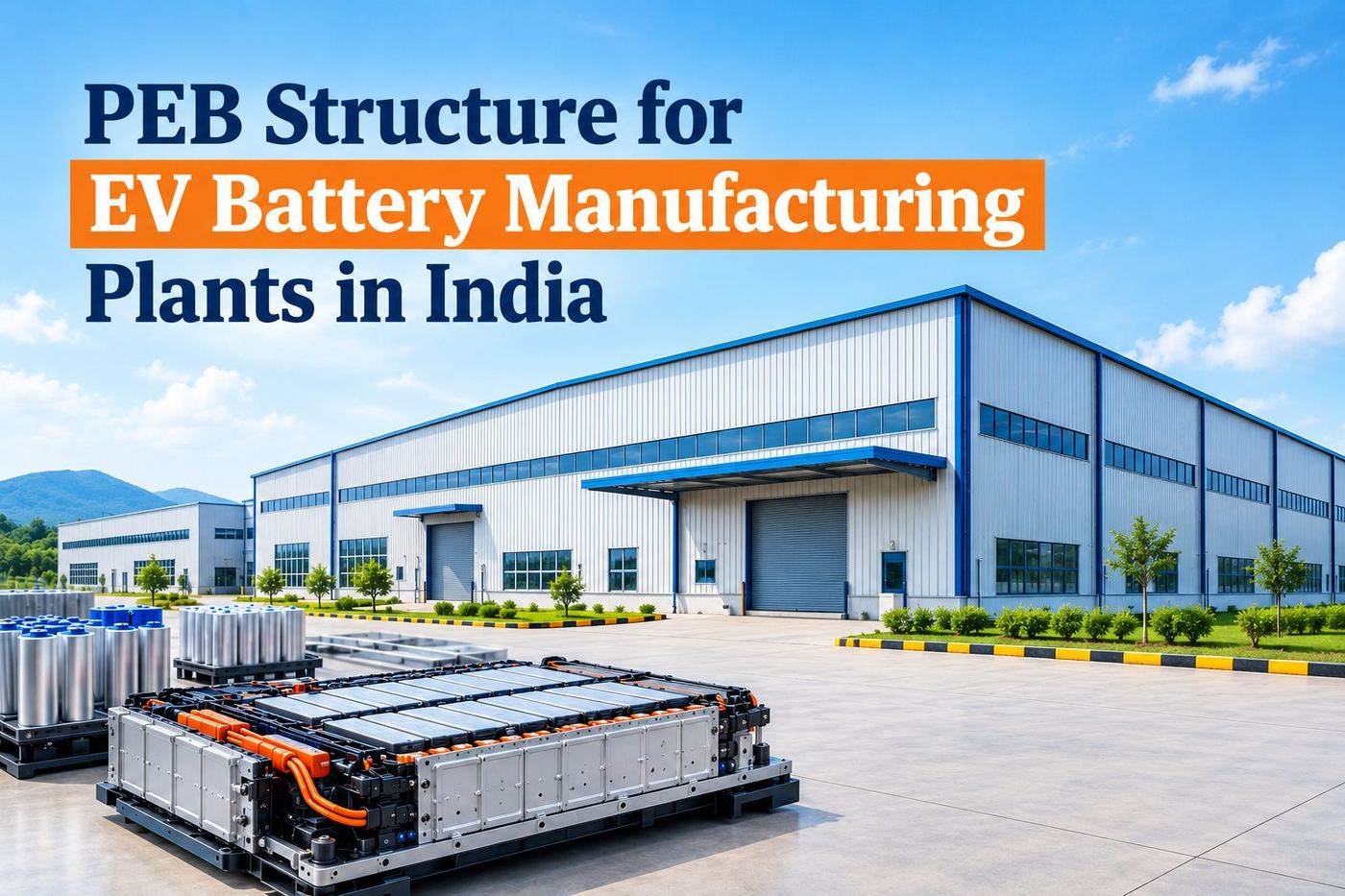
PEB Structure for EV Battery Manufacturing Plants in India
India's electric vehicle industry is moving quickly, and battery manufacturing is becoming an important part of this growth. New battery plants require much more than a large enclosed structure. They need carefully planned production areas, material-handling zones, utilities, ventilation, fire protection and controlled environments for sensitive manufacturing processes.
A PEB structure for EV battery manufacturing plants in India can provide the large structural envelope needed for these facilities while allowing specialized internal spaces to be developed according to the production process.
However, an EV battery plant cannot be approached like a standard warehouse or factory shed. The building has to be planned around the battery chemistry, manufacturing process, equipment, environmental controls and safety requirements.
Table of Contents
- Why PEB Is Being Considered for Battery Manufacturing
- What Makes a PEB Battery Manufacturing Plant Different?
- Is PEB Suitable for Battery Manufacturing?
- Planning the EV Battery Plant Construction in India
- Fire Safety for Battery Manufacturing Plants
- PEB Battery Plant Fire Safety: Design From the Beginning
- How Should Ventilation Be Planned?
- Battery Manufacturing Plant Ventilation and HVAC
- Can a PEB Accommodate Clean Production Areas?
- PEB Cleanroom Manufacturing Facility: What Needs Attention?
- Flooring Requirements for Battery Plants
- Designing Storage Areas Within the Plant
- Structural Requirements for EV Battery Facilities
- Planning the Building for Future Expansion
- What Affects the Cost of a Battery Manufacturing PEB?
- Key Planning Questions Before Construction
- Final Thoughts
- Frequently Asked Questions
Why PEB Is Being Considered for Battery Manufacturing
Battery plants generally require substantial floor areas because production involves multiple stages, equipment and material movement.
PEB for battery manufacturing can offer a practical structural framework for these requirements.
Large Production Areas
Steel buildings can be designed with large spans, providing useful open areas for production equipment and material movement.
Flexible Internal Planning
Production lines, storage zones, utility areas and administrative spaces can be arranged within the larger structural envelope.
Faster Structural Execution
Because major steel components are fabricated before reaching the site, structural erection can be coordinated with other project activities.
Adaptability
Battery manufacturing technology can evolve quickly. A properly planned building can provide opportunities for internal modifications and future expansion.
Read More: PEB Structures for Solar Panel Manufacturing
What Makes a PEB Battery Manufacturing Plant Different?
A PEB battery manufacturing plant has requirements that go beyond the basic structural frame.
The building may need dedicated areas for raw materials, electrode production, cell assembly, formation, testing, packaging and finished-product storage.
|
Facility Area |
Planning Consideration |
|
Raw material storage |
Safe and organized material handling |
|
Production area |
Equipment layout and process flow |
|
Cell assembly |
Controlled environmental conditions |
|
Testing area |
Equipment and utility requirements |
|
Finished battery storage |
Fire and storage considerations |
|
Utility area |
Electrical and mechanical systems |
|
Maintenance area |
Safe equipment access |
|
Administration |
Separate working environment |
The exact requirements depend on the manufacturing technology and battery chemistry being used.
Is PEB Suitable for Battery Manufacturing?
Yes, a PEB can be used as the main structural system for a battery manufacturing facility, provided the building is engineered around the specific manufacturing process.
The steel frame itself is only one part of the facility. Internal clean areas, fire-rated construction, HVAC, electrical systems, drainage and process utilities may require additional systems inside the PEB envelope.
This makes early coordination between the structural designer, process consultant, MEP team and fire-safety professionals particularly important.
Planning the EV Battery Plant Construction in India
EV battery plant construction India requires careful coordination because several systems are installed simultaneously.
The planning stage should establish:
Production Flow
Raw materials should move logically through production without unnecessary crossing of personnel and material routes.
Equipment Locations
Heavy production equipment can influence floor loading, clear heights and structural requirements.
Utility Requirements
Battery manufacturing can require substantial electrical, HVAC, compressed-air and other utility infrastructure.
Material Movement
Forklifts, automated guided vehicles or other handling systems may need dedicated movement routes.
Safety Zones
Areas involving potentially hazardous materials or processes should be appropriately separated.
Fire Safety for Battery Manufacturing Plants
Fire protection deserves particular attention in battery manufacturing because the risks can vary depending on the battery chemistry, materials and manufacturing processes.
Fire safety for battery manufacturing plants should be developed specifically for the facility rather than copied from a conventional factory.
The design team may need to consider:
Fire Detection
Appropriate detection systems can help identify abnormal conditions at an early stage.
Fire Separation
Certain areas may require separation based on their fire risk and the materials or processes involved.
Emergency Access
Emergency routes should allow occupants to leave the facility quickly and provide suitable access for emergency responders.
Fire-Fighting Systems
The appropriate extinguishing and suppression systems should be determined through a project-specific fire-risk assessment.
Battery Storage
Storage areas require particular attention because the quantity, chemistry and arrangement of batteries can influence the risk profile.
PEB Battery Plant Fire Safety: Design From the Beginning
PEB battery plant fire safety should not be treated as something added after the steel building is completed.
Fire-safety requirements can influence the internal arrangement, compartmentation, doors, escape routes, ventilation and service systems.
For example, separating a higher-risk process area from offices or general storage may affect the building layout. Similarly, fire-rated walls or enclosures may need to be incorporated within the main PEB structure.
The final system should be developed according to applicable Indian regulations, standards, local approvals and the specific battery technology used.
How Should Ventilation Be Planned?
Ventilation is an important consideration in battery production because manufacturing processes may generate heat, vapours, dust or other airborne contaminants.
Ventilation for EV battery manufacturing should therefore be designed around individual process requirements rather than treating the entire building as one space.
Process Ventilation
Specific equipment may require local extraction or dedicated ventilation.
General Air Movement
The production area may require controlled air changes to maintain suitable working conditions.
Temperature Control
Certain manufacturing stages may require tighter temperature control than a conventional factory.
Humidity Control
Some battery processes can require carefully controlled moisture levels, making HVAC design particularly important.
Emergency Ventilation
Depending on the process and risk assessment, emergency exhaust or other safety systems may be necessary.
Battery Manufacturing Plant Ventilation and HVAC
The battery manufacturing plant ventilation system should be developed alongside the production layout.
A common mistake is to decide the HVAC arrangement after machinery and rooms have already been finalized. This can create conflicts with ducts, equipment, structural members and maintenance access.
The HVAC design may need to address:
|
Requirement |
Possible Solution |
|
Heat generation |
Cooling systems |
|
Process emissions |
Local extraction |
|
Humidity control |
Dehumidification |
|
Dust control |
Filtration |
|
Controlled areas |
Dedicated HVAC |
|
Air pressure |
Pressure-controlled zones |
|
Maintenance |
Accessible service routes |
The exact system should be determined by qualified HVAC and process specialists.
Can a PEB Accommodate Clean Production Areas?
Yes. A clean production area in PEB can be developed inside the main structural envelope.
The PEB provides the external structural shell, while clean manufacturing areas can be created using specialized internal wall, ceiling, flooring and HVAC systems.
This approach allows the main building to contain different environmental zones.
For example, a facility could have general warehouse space on one side and a controlled production environment in another section.
PEB Cleanroom Manufacturing Facility: What Needs Attention?
A PEB cleanroom manufacturing facility requires more detailed planning than a normal industrial shed.
The cleanroom itself may require:
Controlled Air Quality
Filtration and air-handling systems need to maintain the required cleanliness level.
Controlled Temperature
Temperature should remain within the limits required for the process.
Humidity Management
Moisture control can be particularly important for sensitive battery manufacturing stages.
Specialized Surfaces
Walls, ceilings and floors should be selected according to cleanliness and maintenance requirements.
Air Pressure
Different rooms may require different pressure relationships to control air movement.
The structural PEB and internal cleanroom system therefore need to be coordinated from the design stage.
Read More: PEB for Pharmaceutical Manufacturing
Flooring Requirements for Battery Plants
The factory floor is another important consideration.
Battery manufacturing equipment can be heavy and sensitive to vibration or uneven surfaces. Material-handling equipment can also place significant repetitive loads on the floor.
Depending on the process, the facility may require:
Heavy-Duty Flooring
Suitable for machinery and material-handling equipment.
Smooth Finishes
Useful in controlled production areas where cleaning and maintenance are important.
Chemical Resistance
Certain areas may require flooring systems capable of handling specific substances used in the manufacturing process.
Level Tolerances
Equipment installation may require tighter floor tolerances than general warehouse operations.
The flooring specification should therefore be finalized with the equipment and process requirements in mind.
Designing Storage Areas Within the Plant
Battery plants require storage for raw materials, work-in-progress products and finished batteries.
Storage should not simply be placed wherever spare floor space is available.
The layout should consider:
Separation
Materials with different risk profiles may require separate storage arrangements.
Access
Forklifts and other handling equipment need safe routes.
Fire Protection
Storage arrangements should be reviewed as part of the overall fire-risk assessment.
Inventory Growth
Future production volumes should be considered where possible.
Structural Requirements for EV Battery Facilities
The structural design of the PEB should account for more than the building's own weight.
Potential requirements can include:
|
Requirement |
Why It Matters |
|
Equipment loads |
Heavy machinery affects structural planning |
|
Hanging services |
HVAC and utilities add loads |
|
Crane systems |
Required for certain manufacturing processes |
|
Clear height |
Influences equipment and service installation |
|
Large openings |
Needed for equipment movement |
|
Future expansion |
Allows capacity growth |
|
Roof systems |
May support services and insulation |
The structural engineer should receive accurate equipment and service information before finalizing the design.
Planning the Building for Future Expansion
Battery manufacturing capacity can increase as EV demand grows. A facility designed only for the initial production requirement may become restrictive later.
Expansion can be considered through:
Additional Bays
The building can potentially be planned for future structural extensions.
Utility Capacity
Future electrical and HVAC requirements should be discussed early.
Production Zones
Space can be reserved for additional manufacturing equipment.
Warehouse Expansion
Additional storage capacity can be considered in the site master plan.
Planning for future growth is generally easier before the first structure is fabricated.
What Affects the Cost of a Battery Manufacturing PEB?
The cost of an EV battery facility cannot be estimated by looking only at the steel structure.
Major cost areas may include:
|
Component |
Cost Influence |
|
PEB structure |
Size, height, span and loading |
|
Roofing |
Sheet and insulation specification |
|
Wall system |
Cladding and internal systems |
|
Clean areas |
Specialized panels and finishes |
|
HVAC |
Temperature, humidity and filtration requirements |
|
Fire protection |
Detection and suppression systems |
|
Flooring |
Industrial or controlled-area specification |
|
Utilities |
Electrical and process requirements |
|
Doors |
Industrial or specialized access |
|
Storage |
Racking and safety requirements |
The PEB is therefore only one component of the overall manufacturing facility.
Key Planning Questions Before Construction
Before starting a PEB structure for EV battery manufacturing plants in India, the project team should establish the manufacturing process and building requirements together.
What battery chemistry will be manufactured?
Different chemistries can have different handling and safety requirements.
What production equipment will be installed?
Equipment dimensions, weight and utility connections can influence the building.
Which areas require environmental control?
Not every part of the plant necessarily requires the same temperature, humidity or cleanliness conditions.
Where are the higher-risk areas?
These should be identified during the fire-risk assessment and reflected in the layout.
What production capacity is expected later?
Future expansion can influence the initial structural and site planning.
Final Thoughts
A PEB structure for EV battery manufacturing plants in India can provide an efficient structural framework for large-scale battery facilities, but the building should never be treated as a conventional factory shed.
The success of PEB for battery manufacturing depends on coordinating the structural system with production equipment, HVAC, utilities, fire protection, flooring and controlled manufacturing environments.
Yes, a PEB battery manufacturing plant can include clean production areas, controlled environments and specialized safety systems. However, these requirements need to be developed alongside the structural design rather than added after construction.
For EV battery plant construction India, the safest approach is to involve structural, process, HVAC, electrical and fire-safety specialists early in the planning process. This helps ensure that the building supports the manufacturing process instead of creating restrictions later.
Frequently Asked Questions
What type of PEB structure is generally considered for EV battery facilities?
The structural configuration depends on the plant's dimensions, equipment, clear height, loading requirements and production process. There is no single PEB configuration suitable for every battery facility.
Are battery plants more demanding than ordinary industrial sheds?
Yes. Battery manufacturing can involve controlled environmental conditions, specialized utilities, sensitive production processes and specific fire-risk considerations that are not normally present in a basic industrial shed.
Can clean areas and general warehouse areas exist in the same building?
Yes. Different zones can be created within the same structural envelope, provided the separation, HVAC, access and process requirements are properly designed.
Should fire protection be finalized before the PEB design?
Fire-risk considerations should be introduced during the early design stage because they can influence compartmentation, exits, access, ventilation and internal planning.
Can battery manufacturing buildings be designed for future capacity increases?
Yes. Future expansion can be considered through structural extensions, additional production areas and provisions for increased utility requirements during the initial master planning stage.
Recent Post

Copyright ©2025 All Rights Reserved by nashtechpeb.com