- By Nashtech PEB Team
- Oct 15, 2026
- 0 Views
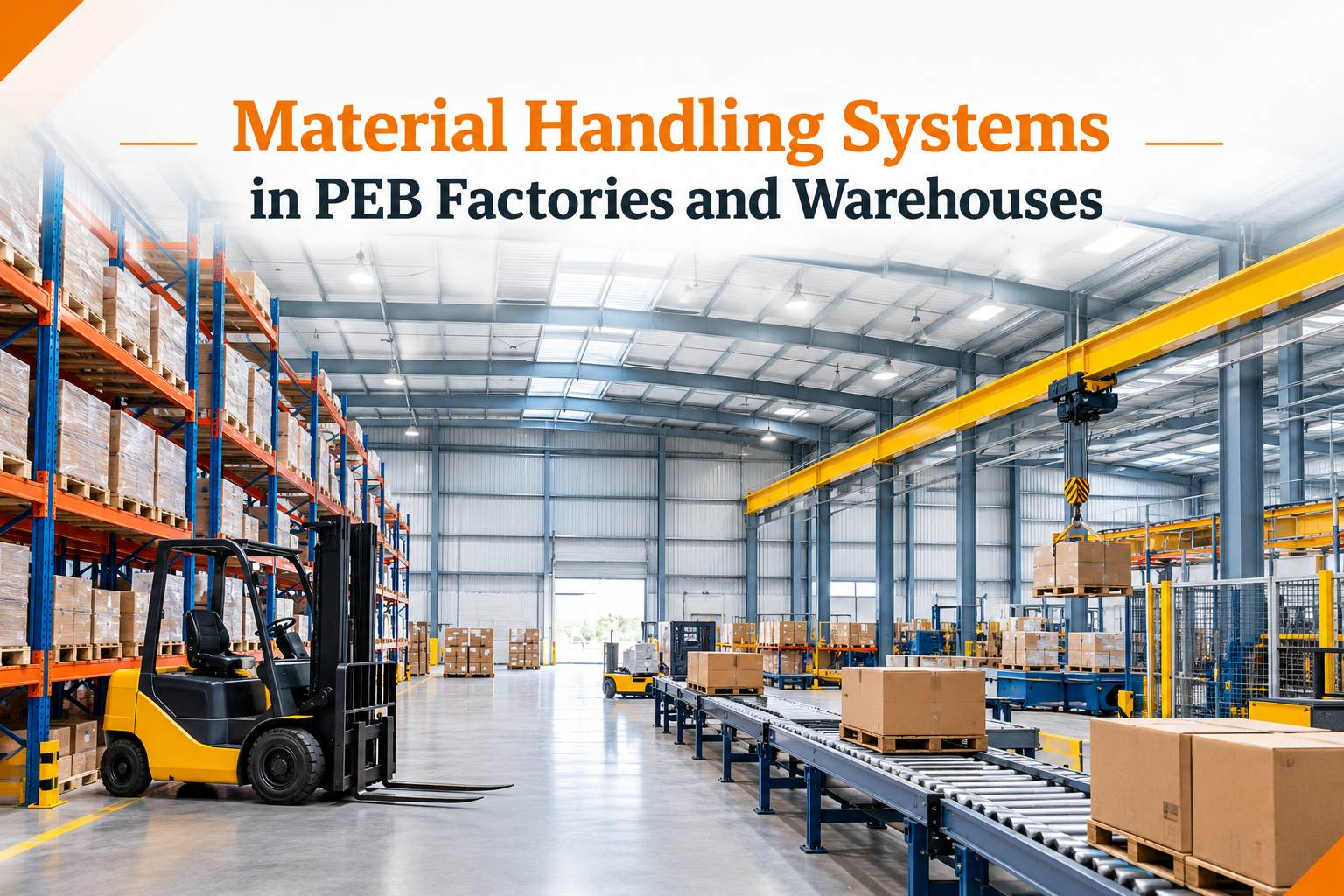
Material Handling Systems in PEB Factories and Warehouses
Ask a plant manager what slows down his shed and the answer is rarely the building. It's the movement inside it. A forklift waiting for another forklift to reverse out of an aisle. A 5 tonne coil sitting on the floor because the crane is busy at the other end. Small delays like these add up to hours every week, and they usually trace back to planning that stopped at the roof. Getting material handling systems in PEB factories right means thinking about the floor, the loads and the traffic before the first column goes up.
Steel buildings help here more than people give them credit for. Fewer columns, higher eaves, frames that can take a crane rail if told about it early. The structure is not the problem. Missing information is.
Table of Contents
- Why a Steel Shed Handles Equipment Better Than Brick
- Equipment You Will Usually See Inside
- Warehouse Gear Is a Different Game
- Start Material Handling System Design on Paper
- Picking Equipment for Your Product
- Laying Out the Floor
- Conveyors Inside a Steel Frame
- EOT Cranes and What They Ask of the Building
- Where Industrial Material Handling Solutions India Are Heading
- Final Thoughts
- Frequently Asked Questions
Why a Steel Shed Handles Equipment Better Than Brick
Picture a conventional godown with a column every five or six metres. Now try running a conveyor line through it, or turning a loaded forklift between pillars. It gets awkward fast. A PEB frame can clear 40 metres or more without a single column inside, so the floor stays open and the layout can follow the work instead of the structure.
Height is the other gain. An 11 or 12 metre eave lets racking go up five or six levels. That is a lot more pallet positions on the same plot, and land in places like Pune, Ahmedabad or around Delhi NCR is not getting any cheaper. Planning material handling systems for warehouses inside that kind of volume gives owners real storage capacity without buying extra land.
Equipment You Will Usually See Inside
Every plant is a little different, but the same machines keep turning up. Typical PEB factory material handling equipment looks like this:
- Overhead cranes for heavy raw material, dies and finished machines
- Forklifts and reach trucks for pallets
- Roller and belt conveyors between workstations
- Jib cranes and hoists at single machines
- Hand pallet trucks and stackers for short, light moves
- Tuggers or AGVs in bigger, newer plants
A fabrication unit leans on cranes. A packaging plant lives on conveyors. A garment exporter mostly needs trolleys and good racking. The product decides the kit, not the other way round.
Warehouse Gear Is a Different Game
In a warehouse the work is storage and retrieval, not making things. Warehouse material handling equipment starts with racking, usually selective pallet racks, sometimes driven in racks where stock is uniform and turns slowly. Mezzanines get added when the floor area runs short but the roof has height to spare.
Then come the machines that serve those racks. Counterbalance forklifts for wide aisles, reach trucks for narrow ones, order pickers when staff need to pull single cartons from height. Bigger fulfillment sites add sorters and pick to light. A 20,000 sq ft distribution godown, though, is often fine with four forklifts and a sensible rack layout. Buying automation too early just locks up cash.
Start Material Handling System Design on Paper
Before choosing any machine, walk the goods through the building on a drawing. Truck arrives, where does it dock? Pallet comes off, where does it go? How far is that from the rack, and then from the rack to the dispatch bay. Good material handling system design shows up in those distances. Every extra 30 metres of travel gets repeated hundreds of times a day.
Tell the PEB manufacturer what you found. Crane capacity, conveyor weight hanging from rafters, rack point loads on the slab, all of it changes the steel and the foundation. Engineers can add a bit of capacity in the design office for very little money. Adding it after erection means cutting, welding and a shutdown nobody wants.
Picking Equipment for Your Product
Choosing material handling equipment for factories starts with weight and shape. Long steel sections need a crane with a lifting beam. Boxed goods ride conveyors. Loose bulk material may need hoppers or bucket elevators. Check the actual heaviest lift, not the average one, because the crane gets sized to that.
Volume is the next question. A unit making 50 pieces a shift can run on manual and semi manual gear for years. A plant running three shifts on one product benefits from automation sooner. And leave room to grow. Equipment that can be extended or upgraded costs less over ten years than something that has to be scrapped at year five.
Also Read: PEB Rice Mill Shed Design
Laying Out the Floor
A decent PEB warehouse equipment layout begins with aisle width. Reach trucks work in roughly 2.8 to 3 metre aisles, standard forklifts need closer to 3.5 or 4. Rack height must match both the building and what the truck can safely lift. Mismatch these and a shiny new machine ends up stacking only to level three.
Keep inbound and outbound separate if the building allows it. Put fast moving stock near the docks. And if the business might double in five years, mark out that future bay on the drawing now, even if it stays empty. Squeezing it in later always costs more.
Read More: PEB Factory Shed With Office Block
Conveyors Inside a Steel Frame
Conveyor systems in PEB buildings work well because the frame can carry them. Roller lines suit cartons. Belts suit loose or odd shaped items. Overhead conveyors move parts between stages while keeping the floor free for people and forklifts.
The catch is weight. Overhead lines hang from purlins or rafters, so the design has to include that load. Floor mounted lines need a flat, level slab, which brings in the flooring spec again. Flag both to the structural team early and the line goes in without surprises.
EOT Cranes and What They Ask of the Building
An EOT crane in PEB factory setups runs on rails fixed to the columns, either on brackets or on separate crane columns. Electric overhead travelling crane is the full name, though everyone on the shop floor just says EOT. It lifts and travels the whole bay, so one machine can serve a long line of work stations.
Capacity changes everything. A 5 tonne crane needs a modest bracket. A 20 tonne crane needs heavier columns, bigger footings and stiffer rafters. Spans, lifting height and duty cycle matter too. Fitting one into a building that was never designed for it usually means strengthening work that costs more than doing it right at the start.
Where Industrial Material Handling Solutions India Are Heading
Demand for industrial material handling solutions India wide is growing quickly, driven by e-commerce, 3PL operators and manufacturers pushing for faster turnaround. Automated storage, robotic picking and warehouse software are showing up in large hubs. Even smaller plants are adding barcode tracking and powered conveyors to cut errors.
Still, plenty of profitable warehouses run on manual systems done well. Start with what the volume actually demands. Then leave some room in the structure and the layout so more advanced systems can be added when the business is ready for them.
Final Thoughts
A good building and a good handling system should be planned together, in the same meetings, with the same drawings. When that happens, goods move cleanly, loads are carried by steel that was sized for them, and nobody is cutting into a new column six months after handover. Skipping that conversation is where most of the pain comes from.
Frequently Asked Questions
1. Can an EOT crane be added to a PEB building later?
Yes, but it usually needs extra work on columns, foundations and rafters. Doing it during the original design is cheaper and far less disruptive.
2. How does clear height affect warehouse handling?
More height allows taller racking and more pallet positions per sq ft. The forklifts or reach trucks must be able to lift safely to that height, so building and equipment have to be chosen together.
3. Do small PEB warehouses need automation?
Usually not at first. A few forklifts, good racking and a clear layout handle most small operations. Automation makes sense once volume and labour costs justify it.
Recent Post
Copyright ©2025 All Rights Reserved by nashtechpeb.com