
- By Nashtech PEB Team
- Apr 22, 2026
- 0 Views
What is LGSF Construction? Light Gauge Steel Framing Explained
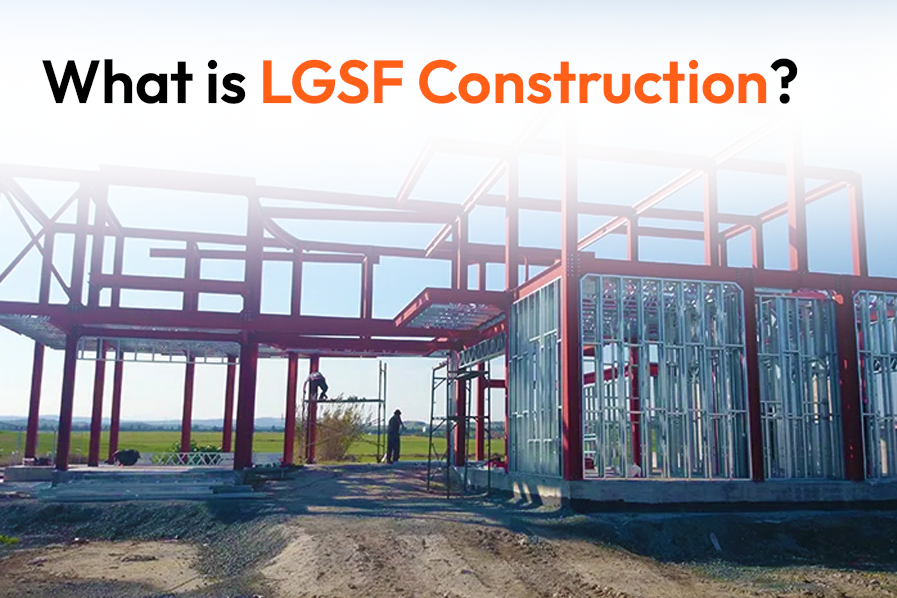
When you go to a place of a construction site where LGSF is being utilized, what immediately crosses your mind is the different feel of the site compared to a normal Indian construction site.
There are no stacks of bricks lying around. You don’t see constant cement mixing. There’s no continuous dust or debris flying everywhere. Instead, you’ll find steel sections neatly arranged, workers assembling components, and a process that looks more organized than chaotic. This is where understanding the light gauge steel framing system in India
becomes important, especially if you're evaluating modern construction alternatives.
And for many people, that first impression itself raises questions—
Is this really strong enough? Is it temporary? Is it expensive?
The truth is, LGSF is not new globally. Countries like the US, Australia, and parts of Europe have been using light gauge steel framing system India (or similar systems) for years, especially in residential construction. In India, it’s just entering that phase where people are starting to understand where it works—and where it doesn’t.
Table of Contents
- What Actually Happens in LGSF Construction (On Ground)
- Why People Still Get Confused Between LGSF and PEB
- Where LGSF is Actually Working in India (Not Just Theory)
- What Changes When You Actually Build Using LGSF
- Advantages of LGSF — Explained Like You’d See Them on Site
- LGSF vs PEB — A Practical Decision, not a Technical Debate
- LGSF Construction Cost — Why It’s Not a Straight Answer
- Where LGSF Can Be a Challenge
- The Mindset Shift Required
- Where LGSF is Heading in India
- Final Thoughts
- FAQs
What Actually Happens in LGSF Construction (On Ground)
To understand LGSF properly, you have to stop thinking of it as “construction” in the traditional sense. It’s closer to assembly than building.
The entire structure is first designed digitally. Every wall panel, every window opening, every connection is mapped out in detail. There is very little guesswork left for the site.
Once the design is finalized:
- Steel coils are processed into thin sections
- These sections are shaped into C and U profiles
- Components are cut and labeled
- Everything is transported to the site
At the site, the job becomes straightforward—assemble according to plan.
This changes a lot of things:
- Less dependency on individual labour skill
- Less adjustment during execution
- Less confusion on-site
With LGSF construction India, the real work happens before the site work begins. And that’s why the site itself feels more controlled. If you compare this with a traditional steel project, the PEB construction process step by step follows a similar pre-planned approach but on a much larger industrial scale.
Why People Still Get Confused Between LGSF and PEB
This confusion is very common. People hear “steel construction” and immediately think everything is the same. Most of this confusion comes from not clearly understanding what is PEB structure and how its purpose differs from LGSF.
So, when you compare LGSF vs PEB, the difference becomes clear very quickly.
PEB (Pre-Engineered Buildings) is designed for:
- Large warehouses
- Industrial sheds
- Factories with wide spans
These structures use heavy steel sections. They are built to carry heavy loads and cover large areas without internal columns.
LGSF is completely different in approach.
It is used for:
- Houses
- Low-rise buildings
- Modular structures
Instead of heavy beams and columns, it focuses on wall framing systems made from lightweight steel.
So the difference is not just in size—it’s in how the building behaves.
- PEB gives you open industrial space.
- LGSF gives you structured, room-based layouts.
Where LGSF is Actually Working in India (Not Just Theory)
There’s always a gap between what sounds good and what actually works on site.
With LGSF construction India, that gap is slowly reducing because real projects are happening now.
Residential Houses
Independent villas are one of the most common applications. Especially in projects where owners want faster construction without compromising design.
Modular Buildings
Site offices, portable structures, labour accommodation—places where speed and repeatability matter more than traditional aesthetics.
Commercial Spaces
Small offices, showrooms, and low-rise buildings are increasingly using light gauge steel framing system India. For larger setups like offices and industrial spaces, commercial steel building construction is still the more practical approach.
Institutional Projects
Schools, clinics, and temporary hospitals where timelines are strict and execution needs to be fast.
What’s important here is this—LGSF is not trying to fit everywhere. It fits where the requirements match its strengths.
What Changes When You Actually Build Using LGSF
The biggest difference is not technical—it’s practical. The workflow changes.
In traditional construction, everything is sequential. One task depends on another. Delays happen because something is always pending.
In LGSF:
- Walls are assembled quickly
- Services like plumbing and electrical can be pre-planned
- Finishing starts earlier than usual
There is less idle time. But this doesn’t mean it’s effortless. It just means the work is better planned.
Advantages of LGSF — Explained Like You’d See Them on Site
Interestingly, many of these benefits overlap with the advantages of pre-engineered buildings, especially in terms of speed and efficiency. Let’s not list benefits like a brochure. Let’s look at how they actually feel during a project.
Speed That Feels Continuous
You don’t see long gaps between stages. Work moves steadily, and that changes how the entire project feels.
Lightweight Structure
The building doesn’t put as much load on the foundation. This can help in areas where soil conditions are not ideal.
Cleaner Construction
Less debris, less water usage, and a more organized site. This becomes important in urban areas.
Design Flexibility
Making changes is easier compared to rigid RCC structures. That gives freedom in planning.
Better Coordination
Since everything is pre-designed, different teams can work with more clarity.
LGSF vs PEB — A Practical Decision, not a Technical Debate
When people compare LGSF vs PEB, they often try to decide which one is “better.” But that’s not the right way to look at it.
If your requirement is:
- A warehouse
- A factory
- A large industrial structure
Then PEB is the natural choice.
If your requirement is:
- A house
- A modular building
- A low-rise commercial space
Then LGSF construction in India makes more sense. The choice becomes simple once you focus on usage instead of comparison. The decision becomes much easier when you understand how to choose the right PEB structure based on your project needs.
LGSF Construction Cost — Why It’s Not a Straight Answer
Cost is always the first question. And honestly, it’s also the most misunderstood part.
When people ask about light gauge framing cost in India, they usually expect a fixed rate. But construction doesn’t work that way. At first glance, LGSF might seem slightly higher than basic RCC in material terms.
But then you notice:
- Construction finishes faster
- Labour costs are lower
- Rework is minimal
- Time-related costs reduce
So the real comparison is not just material—it’s the entire project cycle. And in many cases, the difference becomes much smaller than expected.
Where LGSF Can Be a Challenge
This is something most blogs don’t talk about, but it matters. LGSF requires planning upfront.
You cannot keep changing things during construction like in traditional methods. Decisions need to be taken earlier. For some people, this feels restrictive. For others, it actually improves clarity and reduces confusion.
Also, availability of experienced teams can be a factor in certain regions. Since the method is still growing in India, not everyone is equally familiar with it.
The Mindset Shift Required
What LGSF really changes is not just construction—it changes how you approach a project.
Instead of:
- Making decisions on-site
- Adjusting during execution
- Fixing problems later
You move toward:
- Planning everything in advance
- Finalizing designs early
- Executing with fewer changes
That shift is not easy for everyone. But once adapted, it makes projects smoother.
Where LGSF is Heading in India
Right now, LGSF construction India is still in its early adoption phase, but the direction is quite clear. It is gradually evolving out of being a niche solution to more mainstream, particularly in urban and semi-urban locations where time and space are coming to be a critical consideration.
The government projects, particularly in housing, schools and healthcare facilities are beginning to consider faster methods of construction. That’s where the light gauge steel framing system India fits naturally—because it allows quicker execution without depending too much on traditional labour-heavy processes.
There is also interest among the private developers especially in villa development, plotted development and modular construction. The concept of completing structures in a shorter time and delivering projects in a timely manner is proving to be a good selling point.
Meanwhile, there is increasing awareness. The way LGSF operates in practice is unknown to many. With more successful projects underway becoming visible and more contractors getting on-the-job experience, confidence in the system will rise.
So it is no overnight change--yet it is certainly making progress.
Final Thoughts
If you look at it practically, LGSF construction India is not about replacing traditional methods—it’s about offering a different way to build when the situation demands it. It works best where time matters, planning is clear, and flexibility is needed. It may not suit every project, but in the right context, it simplifies a lot of things that usually slow construction down.
As more people see it in actual use, the hesitation around it will reduce. In the end, it’s less about choosing something new—and more about choosing what works better for the kind of project you are building. If you're planning a project and want clarity on whether LGSF or PEB is the right fit, you can contact Nashtech for your project and get expert guidance.
FAQs
1. Is LGSF construction strong enough for Indian conditions?
Yes, it is. The steel used in LGSF is designed to handle structural loads and environmental conditions. When properly designed and installed, it performs well even in areas with wind or seismic activity.
2. Is LGSF cheaper than traditional construction?
Not always in direct material cost, but when you consider faster construction, reduced labour, and fewer delays, the overall project cost often becomes comparable or even more efficient.
3. Can I build a normal house using LGSF in India?
Yes, many residential houses and villas are now being built using LGSF. It works well for low-rise structures and gives flexibility in design and faster completion.
4. What is the main difference between LGSF and PEB?
PEB is mainly used for large industrial buildings like warehouses, while LGSF is more suitable for residential and smaller commercial structures. The difference is in purpose, not just material.
5. Does LGSF require special contractors or skills?
Yes, it does require teams who understand the system properly. Since the process is more design-driven, working with experienced professionals makes a big difference in execution quality.
Recent Post
Copyright ©2025 All Rights Reserved by nashtechpeb.com