
- By Admin
- 14 March 2026
What is PEB Structure?
Construction has witnessed significant technological advances over the last few decades. The most innovative advancements in contemporary building are called that of the PEB design that is a reference to the Pre-Engineered Building. These structures are constructed and designed in factories before being assembled on the construction site, which makes them more efficient, faster efficient, and economical in comparison to traditional methods of construction.
Presently, PEB buildings are frequently used for factories, warehouses logistic parks, commercial buildings, aircraft hangars and construction projects. Due to their short construction and cost-effectiveness PEB buildings are becoming the most preferred option for industrial construction in India. Many PEB manufacturers are now adopting advanced engineering and factory fabrication methods to deliver high-quality steel structures for industrial and infrastructure projects.
In this comprehensive guide, we will explore what a PEB structure is, the peb structure full form, components of peb structure, peb structure construction process, peb structure cost per sq ft in India, design calculations, advantages of pre-engineered buildings, and the difference between peb and RCC or conventional buildings.
PEB Structure Full Form
It is the PEB structure in its full shape refers to the Pre-Engineered Building.
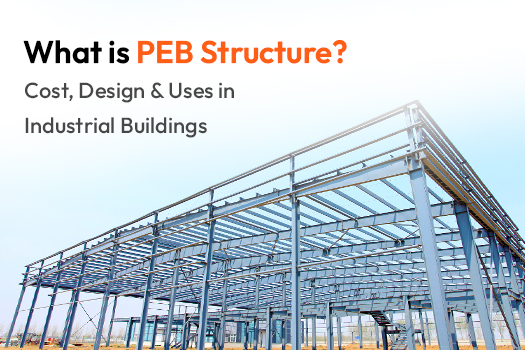
The term "pre-engineered building" refers to a Pre-Engineered Building (PEB) is a steel structure in which components for structural purposes like beams, columns as well as roof structures are created and built in a factory employing the latest engineering techniques. These parts are then shipped to the construction site, and put together using bolts, fasteners and screws.
In contrast to conventional buildings which are constructed entirely on-site, PEB structures are made off-site that ensures accuracy which reduces wastage and faster construction.
Key Characteristics of PEB Buildings
- Steel structural system
- Components made by factories
- Quick assembly on the site
- Lightweight, yet robust construction
- Customizable design
Due to these characteristics, PEB buildings are widely employed for commercial and industrial infrastructure projects.
Types of PEB Structures
PEB structures can be designed in accordance with the requirements of the project. There are various types of PEB structures used across different industries.
Industrial PEB Structures
They are employed in manufacturing plants, factories, or processing plants where large spaces with columns are needed. In many projects, companies prefer customised steel structures that are specifically designed according to operational requirements and industrial layouts.
Warehouse PEB Structures
Warehouses require vast open areas for storage and logistics. PEB structures are perfect because they offer broad-span structures with no need for internal columns.
Commercial PEB Buildings
PEB technology is also utilized to create showrooms, shopping malls as well as office complexes and even exhibition halls.
Agricultural PEB Structures
In the field of agriculture, PEB buildings are used to house poultry farms as well as grain storage units as well as warehouses for agriculture.
Infrastructure PEB Buildings
PEB structures are employed in railway stations, airports as well as sports complexes and metro stations since they be used to cover large areas with ease.
Components of PEB Structure
Understanding the parts of the PEB construction is crucial to comprehend the way these buildings work.
A typical PEB building is comprised of many secondary and structural components.
Primary Structural Members
The primary members are the principal members that carry the load of the building.
They include:- Columns
- Rafters
- Rigid frames
They serve to support the weight of the building as well as transfer the load onto the foundation.
Secondary Structural Members
Secondary members offer structural stability.
They comprise:- Purlins
- Girts
- Eave the struts
- Bracing systems
They aid in spreading loads and assisting with wall and roof panels.
Roof and Wall Panels
The walls and roof in PEB structures are constructed from top-quality steel sheets or insulation panels. Modern roofing and cladding systems are designed to improve weather resistance, insulation performance, and structural durability of industrial buildings.
Common materials are:- Galvanized steel sheets
- Steel panels with color-coated coating
- Sandwich panel with insulation
Building Accessories
A variety of accessories can enhance the performance and function of PEB.
They include:- Skylights
- Roof ventilators
- Louvers
- Downpipes and gutters
- Windows and doors
All these components make up a comprehensive and effective PEB construction system.
PEB Structure Construction Process
PEB structure construction process is a lot faster than traditional structures. PEB structure construction procedure is much quicker than conventional construction techniques due to the fact that the majority of components are made in factories.
Step 1: Planning and Design
The process starts with design and structural planning. Engineers study:
- Building dimensions
- Wind loads
- Seismic loads
- Roof slopes
- The requirements for Span
Modern software such as STAAD Pro and Tekla is used to create precise design.
Step 2: Fabrication
After approval of the design the steel components are then fabricated in factories.
The process of fabrication comprises:- Cutting steel
- Welding
- Drilling
- Surface treatment
- Painting
Factory production assures the highest quality and precision.
Step 3: Transportation
After the fabrication process, all components are delivered on the site of construction.
Step 4: Foundation Construction
Concrete foundations are laid on the construction site while the steel fabrication process is taking place inside the manufacturing facility. This process is parallel to construction and reduces time.
Step 5: Structural Erection
The frames of steel are built with the help of cranes and bolted connections.
The columns and rafters are put together first, then secondary members.
Step 6: Roof and Wall Installation
Wall panels and roof cladding are put in place after the frame structure is completed.
Step 7: Finishing Work
Then, finishing elements like windows, doors and insulation, ventilation systems as well as electrical fixtures are added.
The building is now complete.PEB Structure Cost Per Sq Ft in India
One of the biggest factors in construction is the cost. The PEB structure price per square ft in India typically ranges from:
Rs 1,200 - Rs 2,500 per sq ftHowever, the final price is contingent on a variety of factors.
Factors Affecting PEB Building Cost
- 1. Size and span of the building
- 2. Steel market prices
- 3. Materials for roofing and cladding
- 4. The requirements for insulation
- 5. Building height
- 6. Complexity of structural structures
- 7. Costs of transportation and labor
In comparison with RCC building, PEB buildings can reduce costs by as much as 30-40%.
Difference Between PEB and RCC or Conventional Building
A lot of developers will be comparing PEB structures with RCC buildings in the process of planning the construction.
Here's a table of comparison.| Feature | PEB Structure | RCC Building |
|---|---|---|
| Construction Speed | Very Fast | Slow |
| Cost | Lower | Higher |
| Structural Weight | Lightweight | Heavy |
| Flexibility | High | Limited |
| Expansion | Easy | Difficult |
| Construction Method | Steel that is made in factories | On-site concrete |
Key Difference
The most significant distinction from the peb model and RCC or traditional building is the method of construction.
- PEB buildings make use of steel structures that are made in factories
- RCC structures make use of reinforced concrete built on-site
PEB structures, therefore, give greater performance, flexibility, speed and cost effectiveness.
Advantages of Pre-Engineered Buildings
PEB structures offer a variety of advantages when compared with traditional construction.
Faster Construction
PEB structures can be built 40-60% quicker than traditional structures.
Cost Efficiency
Because the components are made in factories materials are used, waste material and costs for labor are lowered.
High Strength and Durability
Steel structures are extremely resistant against wind loads, earthquakes and severe weather conditions.
Flexible Design
PEB structures permit massive spans that are column-free which is ideal for factories and warehouses.
Easy Expansion
More bays can easily be added to buildings to extend them.
Eco-Friendly Construction
PEB structures are eco-friendly due to the possibility of recycling steel.
Low Maintenance
PEB structures require very little maintenance in comparison to traditional buildings.
PEB Structure Design Calculation
The PEB design calculation is carried out by structural engineers using sophisticated software tools.
The design calculations will ensure that the building will be able to withstand various load.
Loads Considered in Design
- 1. Dead load (weight of the structure itself)
- 2. Live load (people, equipment, storage)
- 3. Wind loads
- 4. Seismic load
- 5. Snow load (in regions with cold temperatures)
These calculations aid in determining:
- Dimensions of beams
- The thickness of the column
- Purlin spacing
- Structural stability
A precise design calculation is vital for ensuring the safety of structures and their durability.
Applications of PEB Structures
PEB structures are widely used across multiple industries due to their flexibility and cost efficiency. Modern industrial buildings also integrate advanced construction technologies such as light gauge framing systems that help create lightweight yet durable structural frameworks.
Common Applications
- Warehouses
- Industrial factories
- Cold storage units
- Shopping malls
- Aircraft hangars
- Metro stations
- Complexes for sports
- Parking structures
- Logistics hubs
Due to their strength and flexibility, PEB buildings are ideal for massive commercial and industrial construction.
Future of PEB Structures in India
India's construction industry is quickly adapting to modern technology and PEB structures are growing in popularity.
With the growth of industrial corridors, logistics parks as well as smart city the need for PEB structures is likely to increase substantially.
Private and public infrastructure projects as well as development projects are promoting the use of pre-engineered structures because of their effectiveness and cost-effectiveness.
Conclusion
A PEB construction (Pre-Engineered Construction) is a modern construction method designed to maximize speed, efficiency and cost-effectiveness. These structures are built in factories and then assembled on site which reduces construction time and costs substantially.
Comparatively to RCC structures, PEB structures provide quicker construction time, more the flexibility of design, a lower price and durability.
PEB technology is rapidly emerging as the future of the Indian industrial construction with increased demand of factories, warehouses and commercial sectors. Nashtech PEB Project Private Limited specializes in delivering advanced steel structure solutions for industrial, commercial and infrastructure projects across India.
In case of a big commercial or industrial project and you think that the PEB structure might help you save some time, save on costs and build strong and long-lasting structures, then you are right.
Frequently Asked Questions (FAQs)
1. What is the full form of PEB structure?
The entire model of the PEB structure can be referred to as the Pre-Engineered Building. It is a steel-based construction system whereby the components are manufactured in a factory, and then assembled at the location.
2. What is the PEB structure price/ sq ft in India?
Approximately the price of the PEB structure in India per square foot can vary between 1200-2500 rupees per square foot depending on the size of construction, materials to be used and even the design of the structure.
3. What are the main components of a PEB structure?
The components of the PEB structure include the main frame (Columns and rafters) and the second party members (purlins and girts) and wall and roof panels and other accessories such as ventilation and skylights.
4. What is the distinction between PEB and RCC building?
The significant key distinction that lies between PEB and RCC structures is the way of construction. PEB constructions are constructed by the use of steel elements produced in factories and RCC constructions are constructed on-site using reinforced concrete.
5. What are the pros of pre engineered buildings?
The benefits of pre-engineered structures are faster construction, reduced cost and flexible design, strong construction, expansion on easy terms and reduced maintenance requirements.

Copyright ©2025 All Rights Reserved by nashtechpeb.com