
- By Nashtech PEB Team
- Apr 06, 2026
- 0 Views
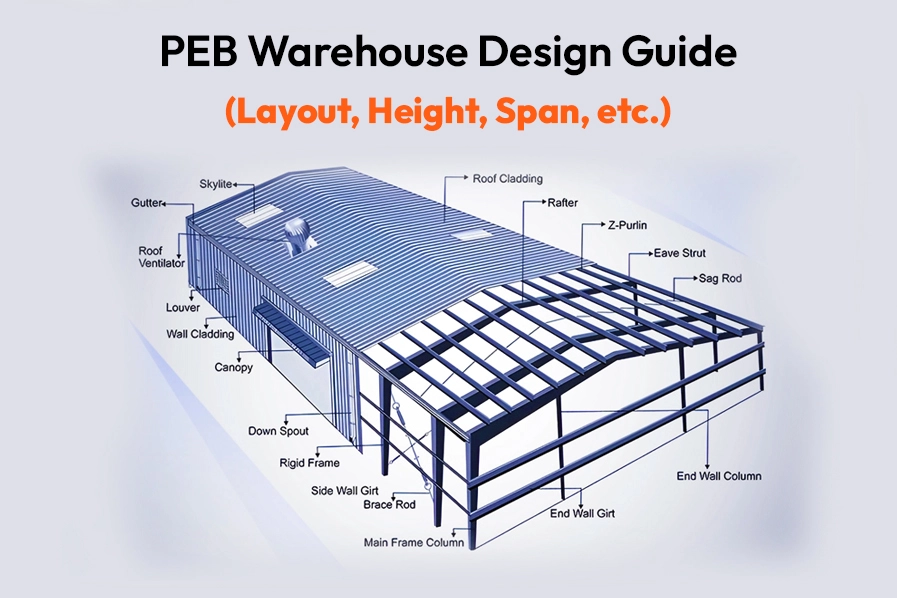
PEB Warehouse Design Guide
The need for efficient infrastructure for warehouses in India is rapidly growing due to the rapid growth of e-commerce, logistics and the industrial sectors. Today, businesses require warehouses that are not just sturdy and durable, but designed to maximize operational efficiency. This is what has created PEB warehouse design and increasingly sought-after solutions for industrial construction in the present day. A well-planned warehouse will ensure more efficient storage management, fluid material flow, and the ability to scale over time, which makes the planning of design a key element in the success of warehouse construction projects. A well-designed warehouse not only improves efficiency but also depends on choosing the right PEB manufacturer in India for long-term performance.
As the pre-engineered buildings (PEB) gain popularity, businesses are striving to enhance the design layout of warehouses in India, which can support construction and operational requirements. The roles of the design include selecting proper size and span to proper venting and loading capacity of all the elements of the design. By applying the proper standards of the warehouse design and a properly structured warehouse plan guide, companies will be able to construct efficient and cost-effective and future-proof storage units.
Table of Contents
- What is PEB Warehouse Design?
- PEB Warehouse Design Factors: Overview
- Warehouse Design Layout in India
- PEB Warehouse Height Design
- PEB Warehouse Span Design
- PEB Warehouse Design Standards
- Warehouse Planning Guide for Industrial Projects
- Key Design Considerations for PEB Warehouse
- Advantages of PEB Warehouse Design
- Applications of PEB Warehouse Design
- PEB Construction Process for Warehouse
- Why Choose PEB for Warehouse Design?
- Final Verdict
- FAQs
What is PEB Warehouse Design?
PEB Warehouse design is the process of designing a warehouse with pre-engineered steel structures. The buildings are planned using advanced software, built in factories and then erected on an assembly site. These projects require expert execution through commercial steel building construction to ensure durability and structural accuracy.
In contrast to traditional building, pre-engineered warehouse building design concentrates on:
- Structural efficiency
- Space optimization
- Speedier construction
- Long-term durability
PEB warehouses are extensively used for:
- Distribution centers and logistics
- Industrial storage units
- E-commerce fulfillment centers
- Manufacturing facilities
Due to these advantages, steel warehouse construction using PEB technology is setting new standards in the construction industry in India.
PEB Warehouse Design Factors: Overview
|
Factor |
Description |
|---|---|
|
Layout Planning |
The efficient movement of goods and efficient utilization of space |
|
Building Height |
It depends on the type of storage and the equipment utilized |
|
Span Width |
Determines the column-free space |
|
Load Capacity |
Based on the storage and operational requirements |
|
Ventilation |
Controls temperature and airflow |
|
Flooring |
Designed to handle heavy loads |
Warehouse Design Layout in India
A carefully planned warehouse design layout in India is crucial to ensure efficient operation. The layout is the basis for how goods are moved within the warehouse and the storage space used. A properly planned layout often relies on customized steel structures that align with operational flow and storage requirements.
Key Elements of Warehouse Layout
- Storage Zones: Separate spaces for finished products, and for dispatch.
- Material Flow Plan: Smooth movement of goods from storage to entry and the time of dispatch.
- The Loading and Unloading Zones: Dock areas designed for ease of access for vehicles.
- Equipment space: Adequate enough space to accommodate conveyors, machinery, and forklifts.
An optimized warehouse layout design improves efficiency, reduces operational delays, and enhances productivity.
PEB Warehouse Height Design
Warehouse height plays an important factor in the effectiveness of storage. Advanced storage solutions can also incorporate mezzanine floor construction to maximize vertical space utilization.
Factors Affecting Warehouse Height
- Storage system of different types
- Rack systems are used to organize items
- Sort of stored merchandise
- Equipment such as forklifts and cranes
Importance of Proper Height Design
- Maximizes vertical storage
- Improves space utilization
- Supports automated systems.
A properly-designed PEB warehouse height provides better storage capacity and efficiency.
PEB Warehouse Span Design
The width of a warehouse refers to the length of columns.
Clear Span Warehouse Design
Clear span design eliminates internal columns, providing open space.
Benefits of Large Span
- Better storage layout
- It is easy to move equipment
- Flexible warehouse operations
The right PEB warehouse span is crucial for efficient use of space.
PEB Warehouse Design Standards
The proper PEB standards for design of warehouses ensures security as well as durability and performance. Proper insulation and protection are achieved using high-quality roofing & cladding solutions in modern warehouse projects.
Key Design Standards
- Calculation of load (dead load live load wind load)
- Structural stability
- Quality standards for materials
- Safety rules
The compliance with these standards guarantees an enduring and reliable warehouse structure.
Read More: Warehouse Construction Using PEB: Benefits, Cost & Design
Warehouse Planning Guide for Industrial Projects
A well-structured warehouse plan guide assists businesses to design efficient and flexible warehouses that are scalable and efficient.
Step 1: Requirement Analysis
Recognize storage needs along with operational flow, as well as potential expansion strategies.
Step 2: Layout Planning
Create the warehouse layout to ensure the highest efficiency.
Step 3: Structural Design
Develop a thorough PEB structure design that is based on the load’s requirements.
Step 4: Material Selection
Choose the best quality steel and roofing materials.
Step 5: Construction and Installation
Implement the project with efficient PEB construction methods.
Key Design Considerations for PEB Warehouse
Load Capacity
Warehouse structures should be able to support:
- Goods stored in stores
- Equipment
- Human movement
Ventilation and Lighting
A good ventilation system ensures that air circulates and natural lighting helps reduce the energy consumption.
Flooring Design
Industrial warehouses require sturdy flooring to accommodate massive loads.
Future Expansion
PEB structures permit an easy expansion to meet growing business requirements.
Advantages of PEB Warehouse Design
Faster Construction
Manufacturing in factories reduces the time to construct substantially.
Cost Efficiency
Optimized design minimizes waste of material and also labor costs.
Flexible Layout
PEB warehouses are able to be laid out in a customized manner according to the operational requirements.
Large Clear Span
Column-free storage spaces increase efficiency.
Durable Structure
Steel structures offer long-term durability. Businesses also explore different types of PEB structures to choose the most suitable warehouse configuration.
Applications of PEB Warehouse Design
PEB Warehouse design is extensively used in:
- Distribution centers and logistics
- Warehouses for E-commerce
- Industrial storage facilities
- Cold storage units
- Manufacturing plants
These applications demonstrate how important it is to consider warehouse planning and design in modern infrastructure.
PEB Construction Process for Warehouse
Steps
- Analysis of requirements
- Structural design
- Fabrication
- Transportation
- Installation
- Final inspection
This ensures quicker and more efficient construction of warehouses.
Why Choose PEB for Warehouse Design?
PEB structures are favored because they offer:
- Faster Project completion speed
- Construction that is cost-effective
- Flexible design options
- Easy expansion
These benefits make PEB warehouse construction the future of industrial infrastructure in India.
Final Verdict
A well-designed PEB warehouse design is essential in enhancing operational efficiency and storage capacity as well as the long-term growth of business. By paying attention to the layout and height, span and design of the structure companies can construct warehouses that are in line with modern requirements of industrial design.
With the growing demands for storage and logistics infrastructure, ensuring that you follow the correct warehouse design layout in India, PEB warehouse design standards, and a structured warehouse planning guide is vital.
The right design approach and collaborating with a skilled PEB manufacturing company in India can ensure the successful construction of a warehouse.
FAQs
1. What exactly is PEB Warehouse layout?
PEB Warehouse design involves preparing and constructing warehouses utilizing steel structures that are pre-engineered for robust and long-lasting performance.
2. What factors affect warehouse design layout in India?
Storage needs, flow of materials equipment use, storage requirements, and space available.
3. What are PEB warehouse design standards?
These include calculations of structural load and safety standards, as well as materials' quality along with engineering principles.
4. Why is warehouse planning important?
A well-planned warehouse plan improves the utilization of space, improves operational efficiency and allows for future expansion.
Recent Post

Copyright ©2025 All Rights Reserved by nashtechpeb.com