
- By Admin
- 20 March 2026
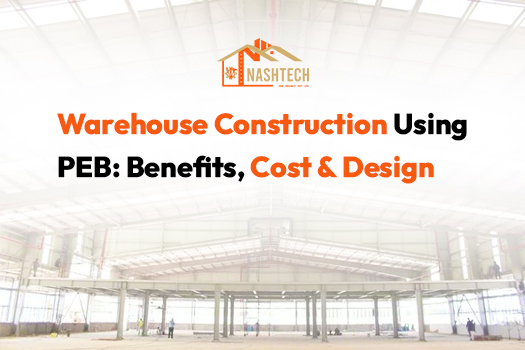
Warehouse Construction Using PEB: Benefits, Cost & Design
India's rapid industrial development and the expansion of logistics networks and growing e-commerce have driven the need in the latest warehouse technology. Today, businesses need warehouses which are quicker to build, cost-effective and able to support massive storage operations. Many businesses now prefer working with Nashtech PEB Project Private Limited, one of the leading PEB manufacturers in India, for building large industrial warehouses using modern pre-engineered steel structures.
Traditional methods of construction, such as RCC as well as brick buildings usually take a lot of time to finish and can be costly. This is the reason investors and developers across India are moving towards building warehouses with PEB (Pre-Engineered Buildings).
The Warehouse made of PEB is constructed of steel and manufactured in a factory before being shipped to the location to be installed. Modern construction methods reduce time to complete, reduces the waste of materials, and assures the highest level of structural precision.
In 2026 Warehouses constructed using PEB are extensively used in warehouse parks as well as industrial storage facilities, Cold storage facilities, as well as factories warehouses. Businesses prefer this method of construction due to the fact that it lets them construct large warehouses in a short time with the same structural integrity as well as cost-control.
In this article we will look at the building of warehouses by using PEB, its benefits, design process, cost in India and the reason PEB is the next generation in warehouse facilities.
What is a PEB Warehouse Building?
The PEB warehouse is the steel structure designed by engineers before being constructed in a factory setting prior to being put together at the site of construction.
In contrast to conventional construction, where components are cut before being put together on the spot, pre-engineered warehouse buildings are built using modern manufacturing software and automated equipment.
The design process involves constructing structural components such as columns, rafters and roof systems based on the requirements for load and dimensions of the building. The components are delivered to the building site and erected by using bolts as well as fasteners.
Key Characteristics of PEB Warehouse Buildings
- Steel components manufactured by factories
- Construction time is faster
- Large spaces with free of column
- High structural durability
- Flexible design for expansion
Since warehouses need large spans and open areas for storage PEB construction has emerged as the perfect solution for storage infrastructures used in industrial operations.
Why PEB is Ideal for Warehouse Construction
Warehouses need to accommodate massive storage volumes, large loads and a smooth logistics flow. Traditional methods of construction do not provide the flexibility required by contemporary supply chain systems.
Warehouse construction with PEB provides a variety of advantages such as quicker project completion, improved structural design, and long-term durability.
Many logistics firms and manufacturing industries, as well as distribution centers are currently opting for steel warehouses within India to help support their growing operations. Companies looking for reliable industrial infrastructure often partner with experienced industrial PEB construction companies in India to build large warehouse facilities quickly.
The strong demand is because of:
- The growth of warehouses for e-commerce
- Expanding the logistics parks
- Industrial corridor development
- The growing need for cold storage infrastructure
These elements have resulted in building warehouses for the PEB industry one of fastest growing industries in construction.
Main Components of a PEB Warehouse Structure
Understanding the elements of the components of a PEB structure for warehouses assists in understanding how these buildings can be built to last and efficiency.
Primary Structural Frame
The primary frame is the core of the structure. It carries the bulk of structural load.
The most important components are:
- Steel columns
- Rafters
- Rigid frames
They form the principal structure skeleton which is the foundation for the entire warehouse. Modern constructed-up steel sections are produced through welding of steel sheets which allows engineers to maximize the strength of their structures where they are needed.
Secondary Structural Members
Secondary members offer additional support and stabilization to the warehouse structure.
They include:
- Purlins: Help to support rooftop panels, and transmit loads to the main structure.
- Girts: Give assistance to wall panels as well as enhance structural stiffness.
- Eave Struts: Connect the wall and roof systems to improve the structural integrity of the entire structure.
In many modern industrial buildings, engineers also integrate a light gauge framing system to create lightweight partitions, internal wall structures, and support elements inside warehouses. These systems are made from cold-formed steel sections that provide high strength while keeping the overall structure lightweight and efficient.
Roofing and Cladding Systems
The roofing and cladding structures protect the warehouse from weather elements.
Common materials are:
- Steel sheets coated with color
- Galvanized steel panels
- Insulated sandwich panels
These materials improve the efficiency of energy as well as durability and resistance.
Additional Accessories
PEB warehouses may include a variety of other systems that can enhance functionality.
Examples include:
- Skylights for natural light
- Roof ventilators to allow airflow
- Mezzanine floor construction to store extra items or office space
- Crane systems for industrial material handling
These features can help increase the productivity of warehouses.
Warehouse Construction Using PEB: Step-by-Step Process
PEB construction procedure is considerably quicker than traditional methods of construction since the majority of components are manufactured in advance.
1. Project Planning and Requirement Analysis
The process starts by the evaluation of project requirements, such as:
- Size of the warehouse
- Storage capacity
- Requirements for loading
- Equipment usage
Engineers study these aspects to determine the best design for the building.
2. Structural Design and Engineering
Structural engineers create detailed drawings and carry out calculation of load.
The design is based on:
- Dead loads
- Live loads
- Wind loads
- Seismic loads
Modern engineering software, such as STAAD Pro and Tekla Structures can be used to guarantee the safety of customised steel structures.
3. Fabrication of Steel Components
After the design has been finalized steel components are manufactured in factories.
The process of fabrication involves:
- Cutting steel plates
- Welding sections of structural construction
- Drilling holes for bolts
- Applying protective coatings
The factory production process ensures constant quality and accuracy.
4. Surface Treatment and Quality Testing
Prior to transportation, steel components undergo protection treatments.
They include:
- Anti-corrosion coatings
- Galvanization
- Quality strength tests
This will ensure longevity and structural durability.
5. Transportation to Construction Site
Fabricated parts are shipped to the site, where the foundation has been laid. When the components are prepared to be installed, the process of preparing the site gets easier.
6. Erection and Installation
Steel frames are erected with cranes and bolted connections.
The process of erection typically includes:
- Columns to be installed
- Connecting to rafters
- Fixing girts and purlins
- Installing wall and roofing panels
7. Final Inspection and Handover
Following installation, the engineers examine the structure for safety and high-quality standards. The warehouse is then prepared for operation.
In general, PEB warehouse construction can be completed between 40 and 60% faster than traditional methods of construction.
Benefits of Warehouse Construction Using PEB
PEB technology has many features that make PEB technology suitable for warehouses in industrial settings.
Faster Construction
Manufacturing in factories permits construction to be completed faster as compared to traditional techniques. This allows businesses to start their operations earlier and get a faster ROI.
Cost Efficiency
Optimized steel design decreases the use of materials and construction costs. The cost of labor is also lower due to the fact that installation is quicker.
Large Column-Free Space
PEB warehouses offer large open spans that allow for better planning of storage and easier moving equipment such as forklifts.
Easy Expansion
Warehouses can be easily expanded by adding structural bays. This flexibility is crucial to grow businesses.
High Structural Strength
Steel structures are extremely resistant against:
- Strong winds
- Earthquakes
- Heavy rain
Sustainability
Steel can be recycled, making PEB construction green.
Low Maintenance
PEB warehouses require less care when compared to traditional structures.
PEB Warehouse Construction Cost in India
One of the main factors for investors to consider is the PEB warehouse construction costs for India.
In 2026, the cost varies between: Rs 1,800 - Rs 3,200 per sq ft
The final price is contingent on a variety of factors.
Factors Affecting Warehouse Construction Cost
Building Size and Span
Larger warehouses with larger spans need more structural and steel reinforcement.
Steel Grade and Thickness
The higher-grade steel is stronger, but it raises costs.
Roofing and Insulation
Premium insulation panels offer more temperature control but are more expensive.
Location and Transportation
The cost of transportation can vary based on the project's location.
Customization Requirements
Other features such as mezzanine floors and cranes and architectural designs that are unique can add cost.
PEB vs Conventional Warehouse Construction
| Factor | PEB Warehouse | Conventional Construction |
|---|---|---|
| Construction Time | Fast | Slow |
| Cost | Lower | Higher |
| Flexibility | Easy expansion | Modification is difficult |
| Maintenance | Low | Moderate |
| Structural Weight | Lightweight | Heavy |
Due to these benefits, PEB warehouses are increasingly being used as a option for storage facilities for industrial use across India.
Applications of PEB Warehouse Buildings
PEB warehouses are employed in various industries.
Common Applications
- Warehouses for logistics
- E-commerce distribution centers
- Cold storage warehouses
- Storage facilities for manufacturing
- Agricultural storage units
- Warehouses for industrial goods
With the growth of India's logistics sector rapidly, the need of the latest warehouse facilities utilizing PEB technology is expected to continue to grow.
Why PEB is the Future of Warehouse Construction in India
India is undergoing a dramatic increase in industrial infrastructure.
The main factors that drive the expansion in the PEB Warehouse construction industry in India are:
- The growth of logistics and supply chains
- Industrial corridors are being expanded
- Rising e-commerce storage demand
- Proposed infrastructure projects by the Government
- Need to speed up construction techniques
Due to these reasons, pre-engineered warehouse structures are predicted to be the dominant industrial construction project over the next several years.
Conclusion
Warehouse infrastructure plays an essential part in supply chains of today. Modern businesses require storage facilities that are constructed quickly, efficiently operate and allow for future expansion.
Warehouse construction with PEB offers the best solution to speed up construction, less expensive as well as a flexible design and long-term endurance. If you are planning to build a modern industrial warehouse, working with top construction companies in India ensures faster construction, better structural design, and long-term durability.
As India's industry sector expands quickly, PEB warehouse buildings are increasingly the choice for manufacturers, logistics companies and the infrastructure builders.
If you choose the right material, design and construction partner businesses can construct warehouses that will support productivity, growth and long-term viability.
Frequently Asked Questions (FAQs)
1. What exactly is warehouse construction with PEB?
Warehouse construction with PEB is the process of building storage facilities with steel structures that are pre-engineered in factories and then assembled on site. This technique reduces construction time and guarantees high structural precision.
2. What is the cost of PEB warehouse construction in India?
It is estimated that the PEB building for warehouses costs in India typically ranges from the range of Rs 1,800 to Rs 3,200 per sq feet based on the dimensions of the building and insulation, quality of steel and the design's complexity.
3. What are the benefits of PEB warehouse buildings?
PEB warehouses have many advantages such as quicker construction, less costs, large spaces with no columns, easily expanding, and superior durability which makes them perfect for industrial storage facilities.
4. How long does it take to construct a PEB warehouse?
The construction of a PEB warehouse is completed between 40 and 60% faster than traditional construction typically taking several weeks to couple of months, based on the scope of the project.

Copyright ©2025 All Rights Reserved by nashtechpeb.com