
- By Nashtech PEB Team
- May 08, 2026
- 0 Views
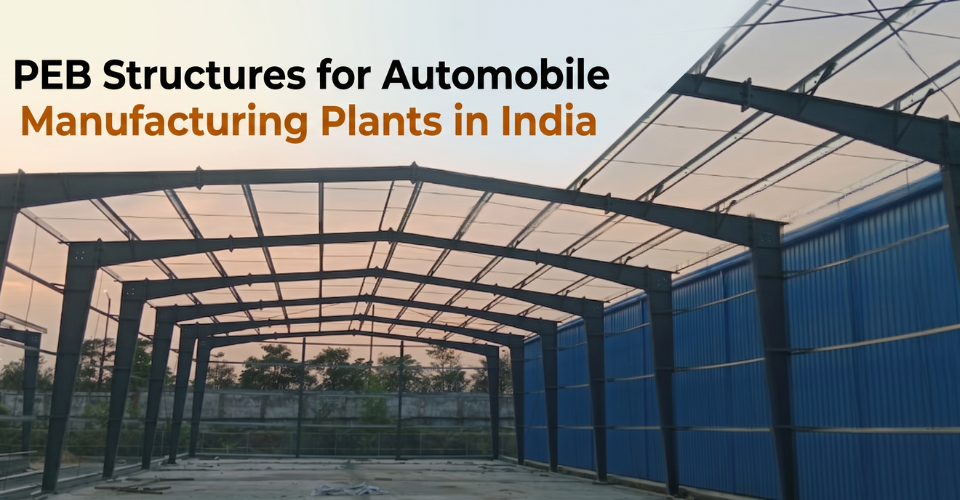
PEB Structures for Automobile Manufacturing Plants in India
If you’ve ever walked inside an automobile plant—not just seen photos, but actually been on the shop floor—you’ll understand one thing very quickly: space is everything. Space is more than size; it is also used.
There are linear assembly lines, the movement of material from one workstation to another, the lifting of large parts by cranes, and coordinated movement by work teams. Everything depends on flow. If that flow is interrupted—even slightly—it starts affecting productivity.
That’s why the structure of the building is not just a background element. It directly affects how the plant performs. This is where PEB structure for automobile plant India has started becoming the preferred choice for many manufacturers. Not because it sounds modern, but because it supports the kind of operations these plants actually need.
Know More: PEB Construction in Rajasthan: Growing Industrial Demand & Key Projects
Table of Contents
Why the Auto Industry Prefers PEB Structures
In automobile manufacturing, buildings are not static. They evolve.
Production lines get upgraded. Equipment changes. Capacity increases. And sometimes, layouts are completely redesigned. Traditional RCC structures can handle load, but they are not always flexible when it comes to these changes. With automotive factory PEB construction, things work a little differently.
Column-Free Spans Make a Real Difference
One of the first things engineers look for in an automobile manufacturing shed in India is how much clear space they can get.
In a real plant:
- Assembly lines are long and continuous
- Movement needs to be uninterrupted
- Machines are placed based on process, not structure
If columns come in between, everything becomes more complicated. You either redesign the layout or compromise on efficiency.
With PEB for auto industry India, larger spans are easier to achieve.
This means:
- Fewer internal columns
- More freedom in layout planning
- Easier movement of materials and equipment
And this is not just a design advantage—it shows up in day-to-day operations.
Crane Compatibility is Not Optional — It’s Essential
Most automobile plants depend on overhead cranes.
You’ll see them everywhere:
- Moving heavy parts
- Lifting engines or assemblies
- Supporting installation and maintenance
In RCC buildings, crane integration often comes later or requires additional structural work. In PEB structure for automobile plant India, crane systems are usually considered from the start.
That includes:
- Crane beam design
- Load calculations
- Structural alignment
This makes installation smoother and reduces complications later.
Faster Construction Means Faster Production Start
This is something that doesn’t get talked about enough. For manufacturers, the building is just one part of the investment. The real value comes when production starts. With RCC, construction can take longer than expected. There are too many dependencies—weather, labour, curing time.
With automotive factory PEB construction:
- Fabrication happens in parallel with site work
- Installation is faster
- Timelines are more predictable
This reduces the gap between investment and production.
Design Specifications for Automobile Manufacturing Plants
Designing an automobile plant is not like designing a warehouse or a commercial building.
Here, design decisions affect:
- Machine placement
- Workflow efficiency
- Maintenance access
Span Requirements Based on Production Layout
In smaller facilities, spans may be moderate. But in larger plants, spans need to be wide enough to accommodate:
- Multiple assembly lines
- Robotic systems
- Conveyor networks
This is where PEB for auto industry India becomes practical because it allows structural design to align with production layout—not the other way around.
Pit Provisions — A Detail That Becomes Critical Later
Many auto plants require pits for machinery. These are not optional features. They are part of the process.
Pits are used for:
- Equipment installation
- Alignment
- Maintenance
If these are not planned properly from the beginning, modifications later become difficult. In automotive factory PEB construction, coordination between structural and civil work becomes important at this stage.
Ventilation — More Than Just Comfort
In automobile plants, ventilation is not about comfort—it’s about safety and efficiency.
Processes like welding and painting generate:
- Heat
- Fumes
- Dust
Without proper ventilation:
- Working conditions become difficult
- Equipment performance may be affected
- Safety risks increase
Modern automobile manufacturing shed India includes:
- Ridge ventilators
- Side louvers
- Airflow planning
PEB structures make it easier to integrate these systems without major structural changes.
Height Requirements for Industrial Operations
Height is another factor that is often underestimated.
Auto plants need height for:
- Crane movement
- Equipment clearance
- Future upgrades
With PEB structure for automobile plant India, achieving required height is simpler compared to RCC.
Cost Range for Automobile Manufacturing Facilities
Cost is always part of the discussion, but in industrial projects, it is rarely just about numbers. When companies evaluate PEB structure for automobile plant India, they look at cost in relation to performance.
What Actually Affects Cost
Some of the main factors include:
- Size of the plant
- Span and height requirements
- Crane integration
- Material specifications
- Additional facilities like offices or mezzanine floors
A basic automobile manufacturing shed India will cost less than a fully equipped facility with all industrial requirements.
Cost vs Practical Value
Instead of focusing only on cost per sq ft, companies consider:
- How quickly the plant becomes operational
- How efficiently it runs
- How easily it can be expanded
In many cases, PEB for auto industry India offers better overall value because of faster construction and flexibility.
Practical Cost Range for Automobile PEB Structures in India
When companies plan an automobile manufacturing shed India, cost is usually evaluated based on how complex the plant requirements are. For a basic PEB structure for automobile plant India, where only structural work is involved, the cost remains moderate and manageable.
However, in real-world automobile plants, additional requirements increase cost, such as:
- Overhead crane systems
- Heavy-duty industrial flooring
- Ventilation and exhaust systems
- Electrical and service integration
In such cases, the cost naturally increases depending on specifications.
Instead of focusing only on cost per sq ft, companies usually evaluate:
- Cost vs production efficiency
- Cost vs construction timeline
- Cost vs long-term flexibility
This is why PEB for auto industry India is often preferred—even when initial costs are slightly higher—because it reduces delays and improves operational performance over time.
Know More: Get Accurate PEB Quote in India: Step-by-Step Guide (2026)
Case Study: Typical 30,000 Sq Ft Automobile Plant
Let’s take a practical example to understand how this works.
Project Overview
- Area: Around 30,000 sq ft
- Purpose: Automobile component manufacturing
- Structure: PEB
What the Client Needed
- Clear space for assembly lines
- Crane system for material handling
- Proper ventilation
- Future expansion possibility
How the Design Was Planned
With automotive factory PEB construction, the focus was on aligning structure with operations.
- Large spans were used to avoid internal columns
- Crane beams were integrated into the structure
- Height was designed for equipment clearance
- Ventilation systems were included in the initial design
Execution Experience
Since most components were fabricated off-site:
- Installation was faster
- Site work was more organized
- Coordination between teams improved
After Completion
Once operational, the plant achieved:
- Smooth workflow
- Efficient material handling
- Minimal layout restrictions
This is where the difference becomes visible—not on drawings, but in daily operations.
One Practical Reality Most People Ignore
There is one thing about PEB structure for automobile plant India that doesn’t get enough attention.
It requires planning discipline. You cannot keep changing things during construction the way you sometimes do with RCC. Decisions need to be made earlier. For some teams, this feels restrictive. But for others, it actually improves clarity and reduces confusion later.
Choosing the Right PEB Partner for Automobile Projects
In automobile manufacturing, the building is not just infrastructure—it directly affects production efficiency.
When selecting a solution for automotive factory PEB construction, companies usually focus on:
- Ability to provide large-span structures
- Experience in crane-integrated buildings
- Understanding of industrial workflow
- Timely project delivery
Choosing the right execution partner ensures that the structure supports operations from day one, without requiring major modifications later.
Final Thoughts
If you look at automobile manufacturing in India today, it’s becoming more structured, more automated, and more efficiency-driven. That naturally affects how plants are designed and built.
PEB structure for automobile plant India is not a replacement for everything—but it fits well where:
- Large spans are needed
- Crane systems are required
- Speed of construction matters
- Future expansion is expected
And once you see it working on an actual shop floor, the difference becomes quite clear.
FAQs
1. Is PEB suitable for heavy automobile manufacturing plants?
Yes, as long as the design is done based on load and operational requirements.
2. Can cranes be integrated easily in PEB structures?
Yes, crane systems are usually planned during the design stage itself.
3. How long does it take to build an automobile plant using PEB?
It is generally faster than RCC due to pre-fabrication and structured installation.
4. Can PEB structures be expanded later?
Yes, expansion is relatively easier compared to RCC.
5. Is PEB cost-effective for auto plants?
It depends on the project, but overall, it often provides better value due to efficiency and speed.
Recent Post
Copyright ©2025 All Rights Reserved by nashtechpeb.com