
- By Nashtech PEB Team
- Jun 16, 2026
- 0 Views
What is Bracing in PEB Structures: Types, Functions & Importance
Modern Pre Engineered Buildings (PEB) are engineered to carry loads much greater than just roof and wall weight. Various wind loads, earthquake forces, crane load and vibration during operation are continuously imposed on industrial buildings, warehouses, factories, logistics buildings and commercial buildings. Bracing systems are another important element in a building's stability, working behind the scenes and of use to primary frames and secondary members.
When designing a PEB building, many project owners direct their planning efforts on columns, rafters and roofing sheets, but it is bracing that is contributing to the overall building performance as well. Even a strong steel structure may have stability problems when exposed to external loads, if the bracing system is not properly designed. That's why it is often said that bracing is one of the most important components to ensure the safety and integrity of PEB steel structures, and durability.
Know More: What is a Canopy in PEB Structures?
Table of Contents
- What is Bracing in a PEB Structure?
- Why Bracing is Important in Steel Buildings
- How Bracing Works in PEB Buildings
- Types of Bracing Used in PEB Steel Structures
- Functions of Bracing in PEB Structures
- Where Bracing is Installed in PEB Buildings
- Materials Used for Bracing Systems
- Factors Affecting Bracing Design
- Common Applications of Bracing in PEB Structures
- Why Proper Bracing Design Matters
- Future of Bracing Systems in Modern PEB Construction
- Conclusion
- FAQs
What is Bracing in a PEB Structure?
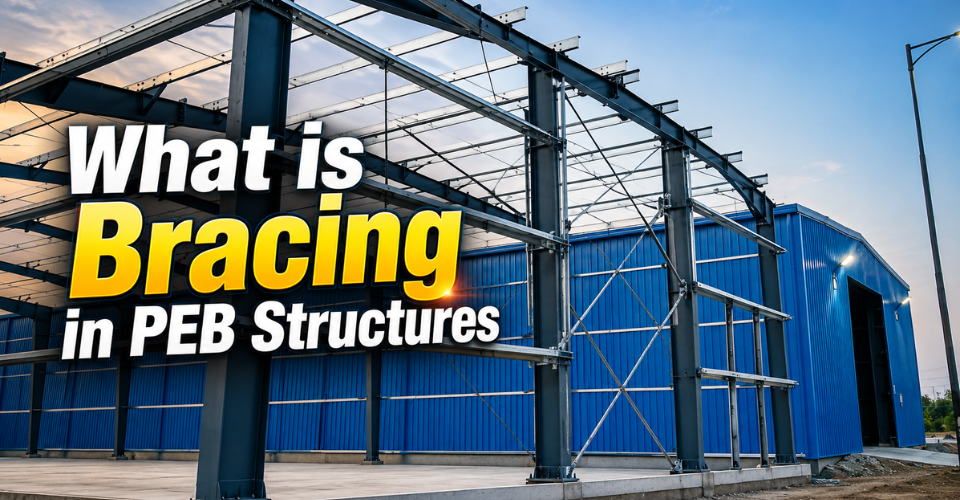
The bracing system consists of steel components that are affixed to the frame of the building in order to provide strength and resistance to forces that are lateral to the structure.
These members are generally placed diagonally between columns, rafters, roof members, or wall systems.
The primary purpose of PEB bracing systems is to:
- Improve structural rigidity
- Resist wind loads
- Handle seismic forces
- Transfer loads safely
- Prevent structural deformation
If bracing isn't done properly the structure could sway too much or be unstable in extreme conditions.
Why Bracing is Important in Steel Buildings
Structures made of steel are intended to be light and efficient. While this provides many advantages, it also means the building requires additional systems to maintain stability.
Bracing helps:
- Strengthen the structure
- Control movement
- Improve load distribution
- Increase safety
- Enhance building performance
This is why steel structure bracing systems are considered essential in industrial construction.
How Bracing Works in PEB Buildings
If earthquakes, wind crane movements, or operating loads affect the structure, forces are pushed throughout the construction.
Bracing members assist in transferring these forces without risk on the ground. As opposed to letting the structure to move around the bracing system supports it and helps distribute load more effectively. This enhances the overall strength of the building.
Types of Bracing Used in PEB Steel Structures
Cross Bracing
Cross bracing is one of the most commonly used bracing systems in industrial PEB structures.
It consists of diagonal steel members arranged in an X-shaped pattern.
Benefits include:
- High structural stability
- Effective load transfer
- Cost-efficient design
- Easy installation
Cross bracing is a common practice in factories, warehouses or industrial warehouses.
Rod Bracing
Rod bracing uses steel rods instead of larger structural members.
It is generally used where loads are moderate and lighter support systems are sufficient.
Advantages include:
- Lightweight construction
- Cost savings
- Faster installation
- Space efficiency
Rod bracing is widely used in roof and wall bracing applications.
Portal Bracing
Portal bracing is used when open space requirements make diagonal bracing difficult.
This system consists of rigid frames designed to resist lateral loads.
Portal bracing is commonly used nearby:
- Large doors
- Vehicle entry areas
- Loading bays
- Open industrial spaces
Knee Bracing
- Knee bracing is placed between rafters and columns to enhance stability in the local area.
- This kind of bracing can help limit frame movement and increase the structural stiffness.
- Knee bracing is often used in industrial sheds and warehouse structures.
Roof Bracing
Roof bracing is installed within the roofing system to stabilize roof members and distribute wind loads effectively.
It helps:
- Maintain roof alignment
- Prevent excessive movement
- Improve overall building stability
Wall Bracing
- Wall bracing is installed between columns along building walls.
- Its main purpose is to resist lateral forces and maintain structural alignment.
- Wall bracing is especially important in large-span industrial buildings.
Read More: Types of PEB Structures Used in Industrial Construction
Functions of Bracing in PEB Structures
Resists Wind Loads
- One of the primary functions of bracing is resisting wind pressure.
- Industrial buildings usually have large walls and roofs which are exposed to strong winds.
- Bracing can help transfer these loads safely onto the foundation.
Improves Earthquake Resistance
- Within seismic areas, structures are required to be able to handle the forces of earthquakes.
- Correctly designed PEB bracing systems increase the capacity of a building in absorbing and spreading seismic load.
- This increases overall structural safety.
Enhances Structural Stability
- Bracing reduces the risk of excessive movement and increases rigidity.
- This ensures balance and strength of the whole structure. This ensures that it is stable and aligned.
Supports Large-Span Buildings
- Modern warehouses and industrial sheds often require large clear spans.
- Bracing helps support these large-span structures without compromising stability.
Protects Structural Components
By distributing loads evenly, bracing reduces stress on:
- Columns
- Rafters
- Roof systems
- Wall systems
This helps improve the lifespan of the building.
Where Bracing is Installed in PEB Buildings
Bracing is typically installed in:
- Roof sections
- Side walls
- End walls
- Column bays
- Crane-support areas
- High-load zones
The exact location depends on building design and load requirements.
Materials Used for Bracing Systems
Modern PEB steel bracing systems commonly use:
- Steel rods
- Steel angles
- Tubular sections
- Structural steel members
The choice depends on building size, load conditions, and engineering requirements.
Factors Affecting Bracing Design
Several factors influence PEB bracing design:
Building Dimensions
Larger buildings typically require stronger and more robust bracing systems.
Wind Conditions
Constructions in high-wind regions require more lateral support.
Seismic Zone
In earthquake-prone zones, structures require extra bracing considerations.
Crane Loads
Buildings that are industrial with overhead cranes create additional forces that affect the requirements for bracing.
Roof and Wall Configuration
The type of roofing and wall systems also affects bracing design.
Common Applications of Bracing in PEB Structures
Warehouses
Large storage facilities rely on bracing to ensure stability over large distances.
Manufacturing Plants
Factories depend on bracing to support loads on machinery and to support operational activities.
Logistics Hubs
Bracing helps maintain structural performance in high-traffic logistics facilities.
Aircraft Hangars
Large structures with clear spans require effective bracing systems to ensure stability.
Commercial Steel Buildings
Commercial projects also rely on bracing to increase security and structural strength.
Why Proper Bracing Design Matters
Poorly designed bracing can create serious structural issues.
Potential problems include:
- Excessive building movement
- Structural instability
- Increased stress on members
- Reduced lifespan
- Safety concerns
This is why professional engineering is essential when designing PEB steel structures.
Future of Bracing Systems in Modern PEB Construction
As industrial buildings become larger and more advanced, bracing systems continue evolving.
Modern engineering software allows designers to create:
- Optimized bracing layouts
- More efficient load paths
- Better seismic performance
- Improved structural reliability
These advances help improve industrial construction structures in terms of safety and strength.
Conclusion
Bracing might not be the most visible part of a building, however, it is among the most vital. It helps maintain stability, improves the distribution of load, enhances security, and aids in helping industrial structures withstand winds or seismic activity as well as operating forces.
It doesn't matter if it's a factory, warehouse logistics hub, warehouse, or the industrial building, having a correctly planned PEB bracing system plays an essential role in ensuring the structural integrity of a building for a long time. As the modernization of industrial construction keeps increasing across India bracing is an essential element which ensures steel buildings are solid, safe and long-lasting.
FAQs
1. What is bracing in a PEB structure?
Bracing is a system of steel members used to improve stability and resist lateral forces such as wind and earthquakes.
2. Why is bracing important in steel buildings?
Bracing improves structural rigidity, distributes loads safely, and increases building safety.
3. What are the common types of bracing used in PEB structures?
Bracing rods, cross bracing, portal bracing knee bracing, roof bracing, wall bracing, are the most commonly employed.
4. Does every PEB building require bracing?
Yes, many PEB constructions require a type of bracing in order to maintain structural integrity and stability.
Recent Post

Copyright ©2025 All Rights Reserved by nashtechpeb.com