
- By Nashtech PEB Team
- Mar 28, 2026
- 0 Views
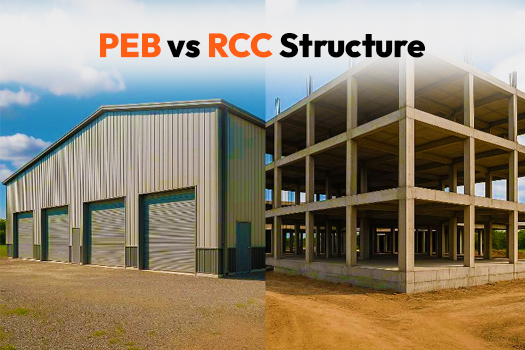
PEB vs RCC Structure
The need for modern warehouses across India is rising quickly because of the expansion of e-commerce, logistics and the industrial sector. Warehouses are essential for businesses today which can be constructed quickly, operate effectively, and provide long-term operations without excessive repairs or delay. This has resulted in an increasing debate between PEB vs RCC building in which decision-makers consider which method of construction provides the best return on investment. The choice of the best design directly affects the timeline of projects as well as operational efficiency and overall cost management during warehouse construction. Many businesses now prefer working with experienced PEB manufacturers in India to ensure faster construction and better cost efficiency in warehouse projects.
While at the same time businesses and developers are moving towards modern technology for construction that offers agility, speed and long-lasting. The debate over steel vs concrete warehouse construction is more pertinent than ever before, particularly in industrial construction. While RCC was a common option, pre-engineered buildings (PEB) are transforming the way warehouses and industrial sheds are constructed. Knowing this industrial shed comparison can help businesses to choose the most effective and future-proof building solution.
Table of Contents
- Overview: PEB vs RCC Structure
- Understanding PEB vs RCC Building
- Key Difference Between PEB vs RCC Structure
- Steel vs Concrete Warehouse – Detailed Comparison
- Industrial Shed Comparison – PEB vs RCC
- Advantages of PEB Structure for Warehouse
- Limitations of RCC Structure for Warehouses
- PEB Structure Design for Warehouse
- PEB Construction Process
- Cost Consideration – PEB vs RCC Structure
- Applications of PEB Warehouse Structures
- Why PEB is the Future of Warehouse Construction
- Why Choose Nashtech PEB?
- Conclusion
- FAQs
Overview: PEB vs RCC Structure
|
Feature |
PEB vs RCC |
|
Construction |
PEB is factory-made steel, RCC is built on-site with concrete |
|
Speed |
PEB is quick, RCC is slow |
|
Cost |
PEB is more efficient in cost, RCC is higher cost |
|
Flexibility |
PEB has a flexible structure, RCC is rigid |
|
Expansion |
PEB is simple to grow, RCC is difficult |
|
Space |
PEB provides column-free space, RCC requires columns |
|
Best Use |
PEB for Warehouses, RCC for residential |
Understanding PEB vs RCC Building
When planning a warehouse construction project one of the most crucial choices is deciding between the PEB structure or the RCC structure. Both of these construction techniques are extensively used, however they differ in regards to design, construction procedure cost efficiency, as well as the long-term performance.
What is a PEB Structure?
The PEB (Pre Engineered Building) is a steel structure which is designed, and manufactured in a factory prior to being put together at the site of construction. The structures are designed using sophisticated software to ensure accuracy and maximize performance. These buildings are designed using advanced engineering tools and customised steel structures to meet specific industrial and warehouse requirements.
PEB buildings are typically used for:
- Warehouses for industrial production
- Logistics hubs
- Manufacturing plants
- Commercial structures
Due to their versatility and effectiveness, PEB construction is now the most preferred option to build modern structures.
What is an RCC Structure?
The RCC (Reinforced Cement Concrete) structure is a traditional method of construction where construction is done on-site with steel reinforcement, concrete, aggregates, and sand.
RCC structures are extensively employed to:
- Residential homes
- Commercial offices
- Multi-storey structures
Although RCC construction is sturdy and long-lasting, it typically takes longer to construct and more labor-intensive construction as compared to PEB buildings.
Key Difference Between PEB vs RCC Structure
Knowing the distinction between PEB and RCC buildings is vital to making the correct decision when it comes to the construction of warehouses.
|
Factor |
PEB Structure |
RCC Structure |
|
Construction Time |
Very Fast |
Slow |
|
Structural Weight |
Lightweight |
Heavy |
|
Cost Efficiency |
Optimized |
Higher |
|
Flexibility |
High |
Limited |
|
Expansion |
Easy |
Difficult |
|
Design Accuracy |
High (factory-made) |
Depends on work at the site. |
Key Insight
The most significant difference is in the construction process:
- PEB structures are factory-fabricated steel systems
- RCC Structures are built on-site with concrete
This can affect project time frames as well as cost and overall effectiveness.
Steel vs Concrete Warehouse – Detailed Comparison
The contrast between steel vs concrete warehouse construction is essential in logistics and industrial projects.
Steel Warehouse (PEB Structure)
A steel warehouse building constructed using PEB technology has several benefits:
- Speedier construction times
- Large, column-free spaces
- Reduction in structural weight
- Simple expansion and modification
These advantages provide PEB perfect in industrial warehouse construction and logistics operations.
Concrete Warehouse (RCC Structure)
An RCC Warehouse structure offers:
- Construction that is strong and robust
- It is suitable for buildings with multiple floors.
- High compressive strength
But, RCC warehouses require longer construction times and greater costs for labor. In the majority of industrial situations, steel warehouse buildings constructed with PEB are more effective over RCC warehouses particularly when it comes to large-scale projects.
Industrial Shed Comparison – PEB vs RCC
Industrial sheds are a crucial application in which the comparison of PEB and RCC structure is crucial.
PEB Industrial Shed
- Large clear span with no columns
- Construction speed is faster
- Use of materials less frequently
- Flexible design
RCC Industrial Shed
- Needs support columns in multiple places
- Construction is slower
- Costs higher
- Flexible, but limited
For this industrial shed comparison, PEB structures clearly have a better use of space and quicker project conclusion. Many industries today rely on an experienced industrial PEB building company to construct efficient and scalable industrial shed structures.
Advantages of PEB Structure for Warehouse
Selecting an PEB warehouse structure has many benefits for logistics and industrial operations.
Faster Construction
PEB structures are manufactured in factories and then assembled on-site which reduces construction time by a significant amount.
Cost Efficiency
The optimized structural design helps reduce cost of materials and labor.
Large Clear Span
PEB structures are designed to provide large space without columns, which increases warehouse efficiency.
Easy Expansion
Warehouses can easily be expanded without significant structural modifications.
Lightweight Structure
Steel structures help reduce the load on foundations and construction costs overall.
High Durability
PEB steel structures provide excellent durability to the environment.
These structures are also integrated with high-quality roofing and cladding systems to ensure durability and protection from environmental conditions.
Limitations of RCC Structure for Warehouses
While RCC is used extensively, it does have some limitations when it comes to warehouse construction.
Slow Construction Process
RCC construction involves curing and several stages, which increases the project's duration.
Higher Cost
Construction that is labor intensive results in cost increases.
Limited Flexibility
Changes and expansions can be challenging to accomplish in RCC structures.
Space Utilization Issues
Columns can reduce warehouse space.
PEB Structure Design for Warehouse
A proper PEB structure design is crucial to ensure the safety of your children and the performance.
Key Design Factors
- Analysis of load (dead load, live load, wind load)
- Structural stability
- Design of slopes on the roof
- Material optimization
- Column spacing
Professional engineers employ advanced tools to develop optimized pre-engineered building design solutions. Modern warehouse designs may also include a light gauge framing system for supporting lightweight partitions and internal structural components.
PEB Construction Process
It is believed that the PEB construction process is quicker and more efficient than RCC construction.
Steps Involved
- Analysis of requirements
- Structural design
- Factory fabrication
- Transportation
- Installation and Erection
- The cladding and roofing
- Final inspection
This streamlined process is one of the key reasons why businesses prefer working with a pre engineered building manufacturer in India for faster project execution.
Cost Consideration – PEB vs RCC Structure
The cost of comparing PEB vs RCC structure is dependent on many aspects like the design, the materials used and project size.
Key Cost Factors
- Building dimensions
- Material selection
- Complexity in structural structure
- Labor regulations
- Location
In the majority of cases, PEB construction provides better cost efficiency due to its faster execution and better materials.
Applications of PEB Warehouse Structures
PEB structures are used extensively in:
- Warehouses for logistics
- Industrial storage units
- E-commerce fulfilment centres
- Manufacturing plants
- Cold storage facilities
These applications show the increasing requirement of Steel warehouses construction in India.
Why PEB is the Future of Warehouse Construction
With the increasing demand for speedier as well as more effective infrastructure PEB building is becoming the most popular choice.
Key Reasons
- Faster project delivery
- Costs of construction are lower
- Flexible design
- Sustainable building solution for sustainable construction
PEB technology is transforming the next generation into industrial warehouse construction in India.
Why Choose Nashtech PEB?
As a reputable PEB construction company, Nashtech PEB provides comprehensive solutions for commercial and industrial projects.
Our Services
- PEB engineering and structure design
- Pre-engineered manufacturing of buildings
- Installation and fabrication of PEB
- Steel building construction
- Construction solutions for warehouses
We are focused on providing effective and reliable construction solutions that meet the needs of modern infrastructure.
Conclusion
The comparison between PEB and RCC building clearly demonstrates that both methods of construction are suitable, however when it comes to storage construction PEB constructions offer more benefits regarding speed, flexibility and effectiveness.
In looking at concrete vs steel construction warehouses or executing one of the industries shed comparison, PEB buildings consistently offer superior performance in industrial uses.
Selecting the right construction method is critical, and working with a leading PEB company in India ensures long-term efficiency, durability, and cost savings for your project.
FAQs
1. What is the different between PEB and RCC construction?
PEB building are structures made from steel made in factories, whereas RCC structures are built on site made of concrete.
2. Which is better for warehouse construction – PEB or RCC?
PEB structures are typically superior due to their speed of construction, a more flexible design and efficient utilization of space.
3. What is steel vs concrete warehouse construction?
Steel warehouses employ PEB systems to speed up and flexible construction. concrete warehouses utilize RCC structures, which take a longer time to construct.
4. Why are PEB structures preferred for industrial sheds?
PEB structures are able to provide huge columns, easy installation, and simple expansion, making them suitable for industrial sheds.
Recent Post



Copyright ©2025 All Rights Reserved by nashtechpeb.com