- By Nashtech PEB Team
- Jun 09, 2026
- 0 Views
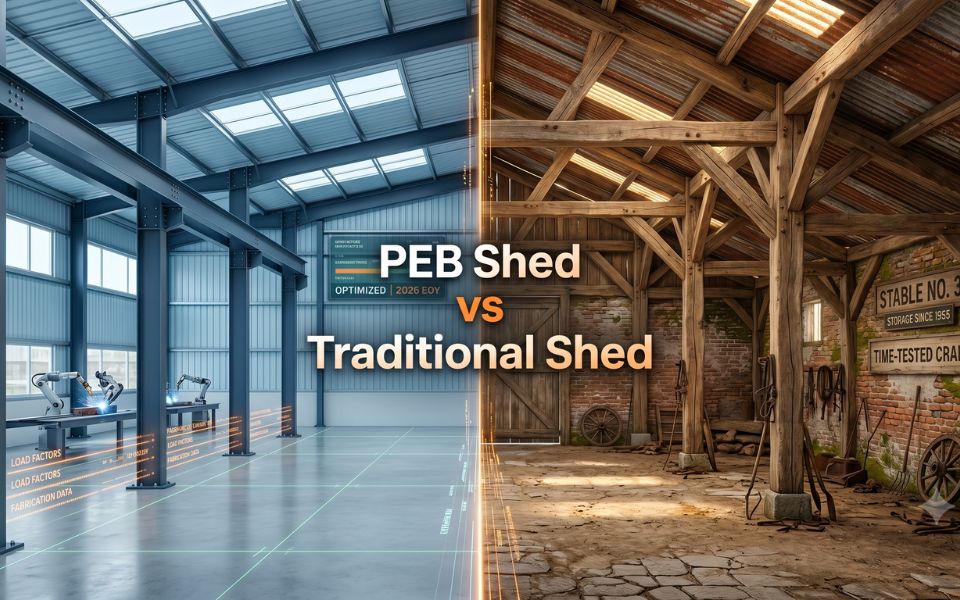
PEB Shed vs Traditional Shed: Which is Better for Industrial Construction?
The construction industry in India has undergone a sea change in the past couple of years. Today, businesses do not want the building to be so time-consuming to build or so costly to operate after a couple of years. It can be a warehouse, factory, logistics center, agricultural shed or a storage facility, but companies are increasingly looking for infrastructure that can be expanded more easily in the future and that will be stronger in terms of performance and speed of construction. One of the major factors why PEB sheds are gaining popularity over conventional shed building in India.
Traditionally, industrial projects have used brick, cement, concrete or heavy steel construction to create a shed. These days, however, the emphasis is on speed, flexibility, durability, and long operating life in modern industries. Pre-engineered Building (PEB) sheds offer a more intelligent solution in construction by optimising steel design, installation time and maintenance costs over traditional building methods. This is why numerous industries are turning to pre-engineered metal structures for their modern industrial building.
Table of Contents
- What is a PEB Shed?
- What is a Traditional Shed?
- Why Businesses Are Moving Toward PEB Sheds
- PEB Shed vs Traditional Shed – Major Differences
- Advantages of Pre-Engineered Metal Buildings
- Why Traditional Sheds Are Losing Popularity
- Popular Applications of PEB Sheds
- Importance of Choosing the Right PEB Shed Manufacturer
- What to Look for in a PEB Construction Company
- Future of PEB Sheds in India
- Conclusion
- FAQs
What is a PEB Shed?
A PEB shed is a steel structure designed and fabricated before reaching the construction site.
Instead of constructing the entire building at the site like traditional construction methods, structural components are manufactured in a controlled factory environment and then assembled systematically during installation.
A modern PEB shed structure generally includes:
- Steel columns and rafters
- Roofing and wall cladding
- Purlins and girts
- Ventilation systems
- Structural accessories
This organized construction method helps improve both project speed and structural efficiency.
Also Read: PEB Industrial Sheds: Why They Are the Backbone of Modern Manufacturing in India
What is a Traditional Shed?
A traditional shed is usually built using conventional construction methods involving:
- Cement and concrete
- Brick walls
- Heavy steel sections
- Wooden frameworks in some cases
These sheds are constructed mostly at the site itself, which increases labor dependency and construction timelines.
Traditional structures have been used for years, but they often create operational limitations for modern industries.
Why Businesses Are Moving Toward PEB Sheds
Industries today operate in highly competitive environments where project delays directly affect business growth.
Companies now require buildings that provide:
- Faster construction
- Lower maintenance
- Better durability
- Flexible expansion
- Cost-efficient operations
This is why many businesses now prefer PEB shed construction instead of conventional shed systems.
PEB Shed vs Traditional Shed – Major Differences
Construction Speed
One of the biggest differences between a PEB shed and traditional shed is project execution time.
Traditional sheds usually require:
- Long on-site construction work
- More labor coordination
- Weather-dependent execution
- Extended finishing timelines
In contrast, pre-engineered metal buildings are fabricated earlier and assembled quickly at the site.
This helps reduce project timelines significantly.
Structural Weight
Traditional RCC and brick structures are generally much heavier.
PEB sheds use optimized steel sections that reduce unnecessary structural weight while maintaining strength.
This also helps reduce foundation load and construction complexity.
Cost Efficiency
Modern businesses focus heavily on cost control during industrial development.
PEB systems help reduce:
- Construction delays
- Material wastage
- Labor requirements
- Long-term maintenance expenses
Because of this, PEB sheds in India are becoming a more cost-effective solution for industrial infrastructure.
Design Flexibility
Traditional sheds often have limitations when it comes to layout modification and future expansion.
PEB sheds provide much better flexibility for:
- Large clear spans
- Mezzanine floors
- Crane systems
- Future extensions
- Customized layouts
This makes them more suitable for changing industrial requirements.
Durability and Strength
Modern PEB steel sheds are designed to handle:
- Heavy operational loads
- Wind pressure
- Seismic conditions
- Harsh weather exposure
Properly coated steel structures also provide long-term durability with lower structural deterioration.
Maintenance Requirements
Traditional structures often develop problems such as:
- Wall cracks
- Roof leakage
- Dampness
- Structural wear over time
In comparison, modern PEB industrial sheds require less maintenance because of:
- Corrosion-resistant coatings
- Engineered roofing systems
- Better structural precision
This helps industries reduce repair and operational costs.
Advantages of Pre-Engineered Metal Buildings
Faster Installation
Since structural components are pre-manufactured, installation becomes much faster compared to conventional construction.
This helps businesses begin operations earlier.
Better Space Utilization
PEB structures support large clear-span layouts with fewer internal columns.
This improves:
- Storage planning
- Machinery movement
- Inventory management
- Operational workflow
Easier Expansion
As businesses grow, infrastructure requirements also increase.
One major advantage of PEB shed buildings is that future expansion becomes much easier compared to traditional structures.
Environment-Friendly Construction
Modern PEB construction systems support sustainable building practices because they:
- Reduce material wastage
- Use recyclable steel materials
- Minimize unnecessary site work
This makes them an eco-friendlier industrial construction solution.
Why Traditional Sheds Are Losing Popularity
Traditional industrial sheds still work in some situations, but many businesses now find them less practical because of:
- Longer construction timelines
- Higher maintenance
- Limited flexibility
- Increased labor dependency
- Expansion difficulties
Modern industries require buildings that can adapt quickly to changing operational needs.
This is why modern PEB sheds are replacing many conventional industrial structures.
Popular Applications of PEB Sheds
Industrial Manufacturing Units
Factories require large-span buildings for machinery and production systems.
Warehouses and Logistics Hubs
Storage facilities need organized layouts and expansion flexibility.
Agricultural Storage Buildings
PEB sheds are widely used for crop storage and farming equipment protection.
Cold Storage Facilities
Insulated PEB structures help maintain temperature-controlled environments.
Vehicle and Machinery Shelters
Steel sheds provide durable protection for industrial equipment and transport vehicles.
Importance of Choosing the Right PEB Shed Manufacturer
The quality of a PEB project depends heavily on the experience and capability of the manufacturer.
A professional PEB shed manufacturer ensures:
- Accurate engineering
- Proper structural design
- High-grade steel usage
- Timely project execution
- Quality fabrication standards
This directly affects building performance and long-term durability.
What to Look for in a PEB Construction Company
Before selecting a PEB construction company, businesses should check:
- Industry experience
- In-house design capabilities
- Material quality standards
- Customization options
- Project execution track record
- After-sales support
Choosing the right partner helps avoid future structural and operational problems.
Future of PEB Sheds in India
India’s industrial and logistics sectors are expanding rapidly.
Growing demand from:
- E-commerce
- Warehousing
- Manufacturing
- Cold chain logistics
- Infrastructure projects
is increasing the need for faster and more efficient construction systems.
Therefore, PEBs will be expected to have a significant impact in future industrial development in India, owing to their ability to shed.
Conclusion
Buildings in modern industries have to be built quickly, maintained easily and extendable. In some projects, traditional sheds remain in use, but they may not be as fast and efficient as the demands of today's industrial environment.
That's why PEB sheds are becoming the wise option for the warehouse, factory, logistics and industrial facilities. Pre-engineered metal buildings are one of the most practical solutions for today's infrastructure projects because of their ease of installation, durability, low maintenance, and design flexibility.
With the rapid growth of industrialization in India, the future of industrial construction with PEB technology is set to continue changing.
FAQs
1. What is a PEB shed?
A PEB shed is a pre-engineered steel structure fabricated before installation at the project site.
2. Why are PEB sheds better than traditional sheds?
They provide faster construction, better durability, lower maintenance, and easier expansion.
3. Which industries commonly use PEB sheds?
Warehousing, manufacturing, agriculture, logistics, and cold storage industries commonly use them.
4. Are PEB sheds cost-effective?
Yes, they help reduce construction time, labor costs, and long-term maintenance expenses.
Recent Post
Copyright ©2025 All Rights Reserved by nashtechpeb.com