
- By Nashtech PEB Team
- May 20, 2026
- 0 Views
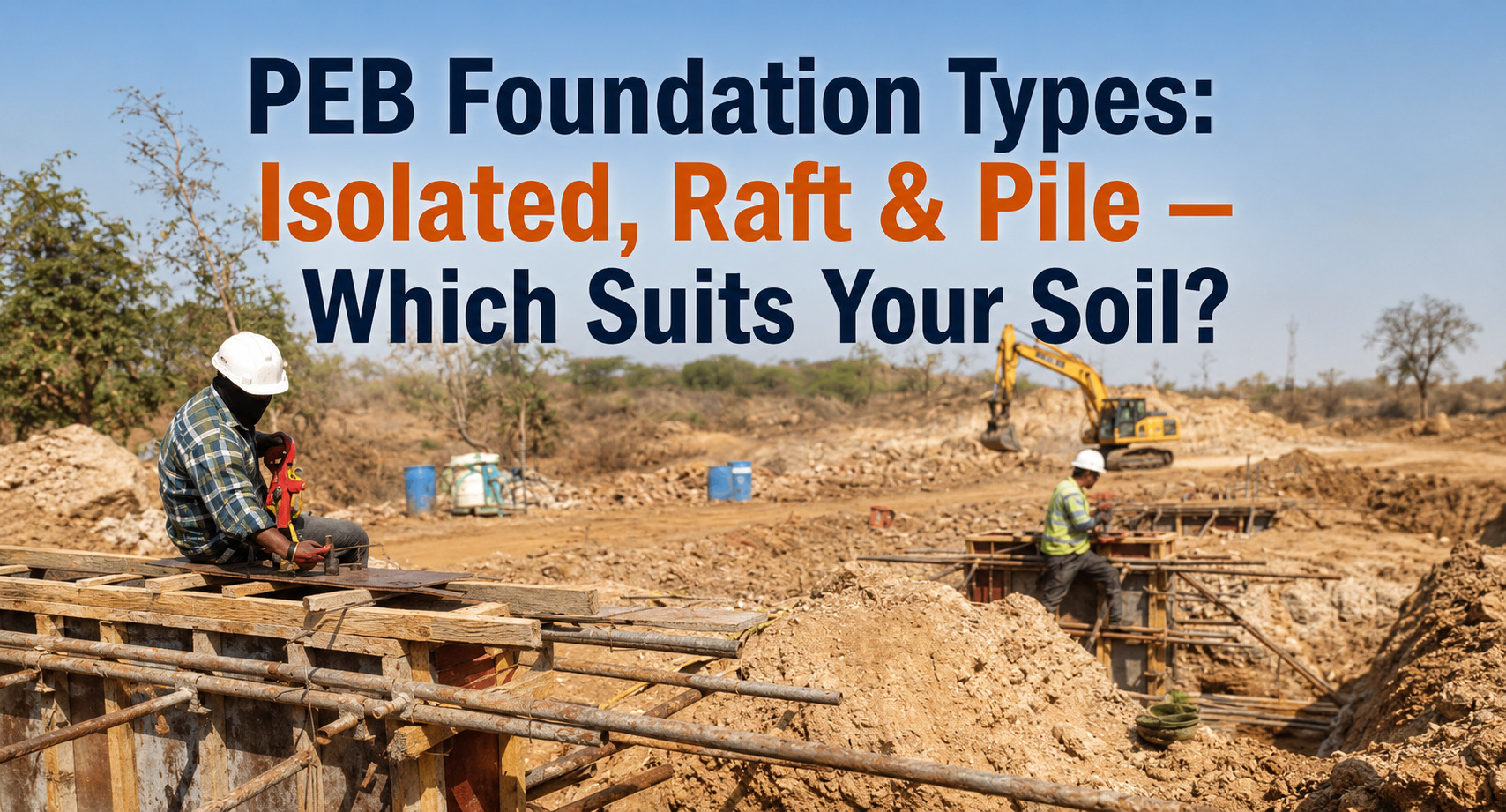
PEB Foundation Types: Isolated, Raft & Pile — Which Suits Your Soil?
A PEB structure may look simple once construction is completed, but the real strength of any industrial building starts below ground level. Even the strongest of the steel structure can have a long-term structural problem if the foundation planning is poor. This is why it is best to have an experienced engineer look at the soil conditions before deciding on the foundation system. The foundation isn't just a concrete base of a building, it is the component which transfers the load of the entire structure to the ground safely in industrial projects.
For many businesses, the key consideration with warehouse or industrial shed construction is the design of the steel structure, the roof or the construction speed, but they do not consider the appropriate type of PEB foundation. In fact, the stability, safety, durability, and performance of a building are influenced directly by the soil. The determination of whether to use an isolated foundation for PEB, a raft foundation or a pile foundation for steel buildings depends primarily on the strength of the soil, load conditions and site requirements.
Table of Contents
- Why Foundation Design Matters in PEB Construction
- How Soil Conditions Affect Foundation Selection
- Main Types of Foundations Used in PEB Buildings
- What is an Isolated Foundation?
- When Isolated Foundations Work Best
- Advantages of Isolated Foundations
- Limitations of Isolated Foundations
- What is a Raft Foundation?
- When Raft Foundations Are Preferred
- Advantages of Raft Foundations
- Limitations of Raft Foundations
- What is a Pile Foundation?
- When Pile Foundations Are Needed
- Advantages of Pile Foundations
- Limitations of Pile Foundations
- How Engineers Decide the Right Foundation Type
- Why Soil Testing is Important Before PEB Construction
- Common Mistakes in PEB Foundation Planning
- Why Foundation Planning is Critical in PEB Buildings
- Future of Foundation Design in Industrial PEB Construction
- Conclusion
- FAQs
Why Foundation Design Matters in PEB Construction
A pre engineered building (PEB) is lighter than traditional RCC structures, but that does not mean foundation planning becomes less important.
The foundation must safely handle:
- Structural load
- Wind load
- Crane load in some industries
- Soil settlement pressure
- Operational vibrations
If the foundation is not suitable for the soil condition, problems may start appearing over time.
Some common issues include:
- Uneven settlement
- Cracks in flooring
- Structural imbalance
- Water-related foundation damage
That is why PEB foundation design is considered one of the most critical stages in industrial construction.
How Soil Conditions Affect Foundation Selection
Every construction site has different soil behavior.
Some soils are naturally strong and stable, while others may be soft, loose, or moisture-sensitive.
Before selecting a foundation system, engineers generally study:
- Soil bearing capacity
- Water table level
- Soil settlement behavior
- Ground stability
- Structural load requirements
This process helps determine which foundation type for PEB structure will perform best at the site.
Main Types of Foundations Used in PEB Buildings
In industrial PEB construction, three foundation systems are commonly used:
- Isolated foundation
- Raft foundation
- Pile foundation
Each foundation type is suitable for different soil and load conditions.
What is an Isolated Foundation?
An isolated foundation for PEB is one of the most commonly used foundation systems in industrial buildings.
In this method, individual footings are constructed under each structural column.
These footings transfer the load directly to the soil beneath them.
When Isolated Foundations Work Best
Isolated foundations are generally suitable when:
- Soil bearing capacity is good
- Structural loads are moderate
- Settlement risk is lower
- Ground conditions are stable
This type of foundation is commonly used in:
- Small industrial sheds
- Warehouses
- Medium-span PEB structures
Because of its relatively simple construction process, isolated footing systems are widely used in PEB warehouse construction projects.
Advantages of Isolated Foundations
Cost-Effective Construction
For sites with strong soil conditions, isolated foundations are usually more economical compared to raft or pile systems.
Faster Construction
Since each footing is constructed separately, execution becomes relatively faster.
Simple Structural Layout
The design and execution process are comparatively straightforward for smaller and medium industrial projects.
Limitations of Isolated Foundations
Isolated foundations may not perform well in:
- Weak soil conditions
- High settlement zones
- Heavy industrial load applications
In such situations, other foundation systems become more suitable.
What is a Raft Foundation?
A raft foundation in PEB buildings is a large continuous concrete slab supporting multiple columns together.
Instead of separate footings under each column, the entire building load spreads across one combined foundation slab.
This helps distribute structural loads more evenly.
When Raft Foundations Are Preferred
Raft foundations are commonly used when:
- Soil bearing capacity is moderate
- Settlement risk exists
- Column loads are closely spaced
- Uniform load distribution is required
This type of foundation is often preferred in:
- Large industrial buildings
- Heavy warehouse structures
- Soft soil construction sites
Advantages of Raft Foundations
Better Load Distribution
Raft foundations spread the load across a larger area, reducing pressure on the soil.
Reduced Differential Settlement
Since the structure rests on one connected slab, uneven settlement risk becomes lower.
Suitable for Moderate Soil Conditions
Where isolated footings may struggle, raft systems often perform more reliably.
Limitations of Raft Foundations
Raft foundations generally require:
- Higher concrete usage
- More reinforcement steel
- Larger excavation work
This may increase construction cost compared to isolated footings.
What is a Pile Foundation?
A pile foundation for steel buildings is used when surface soil is too weak to support structural loads safely.
In this method, long vertical piles are driven or cast deep into the ground until they reach stronger soil layers.
The building load is then transferred to deeper stable strata.
When Pile Foundations Are Needed
Pile foundations are generally preferred when:
- Soil bearing capacity is very low
- Water table is high
- Heavy industrial loads exist
- Deep stable soil layers are available
This system is commonly used in:
- Large industrial plants
- Heavy manufacturing units
- Multi-level industrial facilities
Advantages of Pile Foundations
Suitable for Weak Soil
Pile systems help support structures even in poor soil conditions.
Better Stability for Heavy Loads
They are ideal for industrial projects carrying large structural and operational loads.
Reduced Settlement Risk
By transferring load deeper underground, settlement problems become more manageable.
Limitations of Pile Foundations
Pile foundations usually involve:
- Higher construction cost
- Specialized equipment
- Longer execution time
However, in weak soil conditions, they often become necessary rather than optional.
How Engineers Decide the Right Foundation Type
Foundation selection is never based only on building size.
Engineers usually evaluate:
- Soil test reports
- Structural load calculations
- Groundwater conditions
- Future expansion possibility
- Crane load requirements if applicable
A proper soil test for PEB foundation plays a major role in this decision-making process.
Why Soil Testing is Important Before PEB Construction
Many construction issues began because proper soil investigation was ignored.
A soil test helps identify:
- Safe bearing capacity
- Soil settlement behavior
- Moisture conditions
- Foundation suitability
Without this information, choosing the correct industrial building foundation type becomes difficult.
Common Mistakes in PEB Foundation Planning
Ignoring Soil Investigation
Skipping soil testing to save initial cost often creates larger structural problems later.
Choosing Foundation Only Based on Budget
The cheapest foundation option is not always the safest for long-term performance.
Not Planning for Future Expansion
Future building extension may increase structural load, which should be considered during foundation planning itself.
Why Foundation Planning is Critical in PEB Buildings
PEB structures are designed for efficiency and optimized steel usage. Because of this, foundation alignment and stability become extremely important.
A properly planned PEB foundation system helps ensure:
- Structural safety
- Long-term stability
- Controlled settlement
- Better building performance
Without strong foundation support, even the best steel structure may face operational issues later.
Read More: Types of PEB Structures Used in Industrial Construction
Future of Foundation Design in Industrial PEB Construction
Industrial construction is becoming more engineering-focused than ever before.
As warehouses, logistics parks, and manufacturing units continue growing across India, demand for:
- Soil-optimized foundation systems
- Heavy-load industrial foundations
- Faster foundation execution methods
Will continue increasing.
This is why modern PEB foundation engineering is now heavily focused on both structural efficiency and soil compatibility.
Conclusion
The strength of a PEB structure does not begin with steel columns or roofing sheets — it begins with the foundation below the ground.
The most suitable foundation type for PEB building is isolated, four corner foundation, raft foundation or pile foundation, which depends on soil conditions, load demand and subsequent use of the buildings.
Understanding the best foundation for the soil of your business can help you prevent structural issues for the long term and improves the performance of buildings. When it comes to industrial construction, correct foundation design isn't just an engineering requirement, it's one of the most important decisions that will affect the lifespan of the entire structure.
FAQs
1. Which foundation is commonly used in PEB buildings?
Isolated, raft, and pile foundations are the most commonly used foundation systems in PEB construction.
2. When is a raft foundation preferred?
Raft foundations are preferred when soil conditions are moderate and even load distribution is required.
3. Why are pile foundations used in industrial buildings?
Pile foundations are used when surface soil is weak and deeper stable soil layers are needed for support.
4. Why is soil testing important before PEB construction?
Soil testing helps determine soil strength, settlement behavior, and the most suitable foundation type for the building.
Recent Post
Copyright ©2025 All Rights Reserved by nashtechpeb.com