- By Nashtech PEB Team
- Nov 18, 2026
- 0 Views
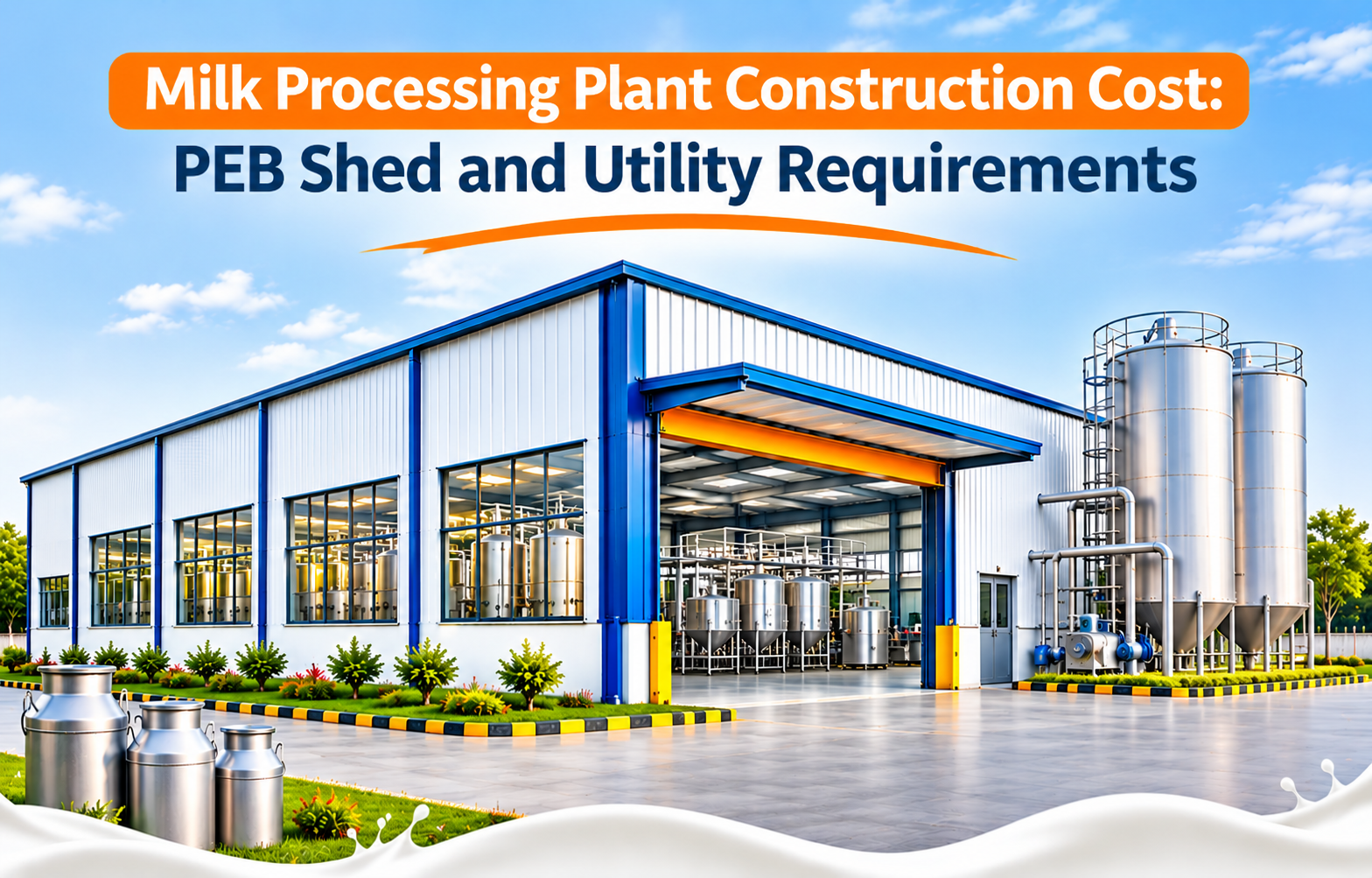
Milk Processing Plant Construction Cost: PEB Shed and Utility Requirements
Explore milk processing plant construction cost in India, PEB shed prices, dairy plant layout, utility requirements, and 10,000 LPD plant budget.
Many first-time dairy investors start with a simple idea: build a steel shed, put the machines inside, and start packing milk. Then the food safety inspector visits, the floor starts holding water, the walls sweat in summer, and the boiler needs approvals nobody planned for.
A milk plant is a food factory. It needs clean surfaces, cold rooms, steam, lots of water and a proper way to treat wastewater. All of that affects the building and the budget. This guide covers the real milk processing plant construction cost, how to design the PEB shed for hygiene, and the utility requirements you need to plan from day one.
Table of Contents
- How Much Space Does a Milk Plant Need?
- Designing the PEB Shed for a Dairy
- Milk Plant Construction Cost Per Sq Ft
- Utility Requirements for a Milk Processing Plant
- Sample Budget: 10,000 LPD Milk Plant (Building and Utilities)
- Approvals and Compliance
- Tips to Control Your Dairy Construction Cost
- Final Word
- FAQ's
How Much Space Does a Milk Plant Need?
NABARD's model project for a 10,000 litres per day (LPD) milk plant suggests about 2 acres of land, with built-up area roughly one-third of the total. The processing building itself is often around 4,000 sq ft, but that grows quickly once you add cold storage, a lab, stores and utilities.
Dairy planning guides use a simple rule of thumb: small plants under 10,000 LPD need about 6 to 7 m² per 100 litres of milk, while medium plants need about 2 to 3 m² per 100 litres.
|
Plant capacity |
Approx. built-up area |
Approx. land |
|
5,000 LPD |
3,000 – 4,000 sq ft |
1 – 1.5 acres |
|
10,000 LPD |
4,000 – 7,500 sq ft |
about 2 acres |
|
25,000 LPD |
6,000 – 10,000 sq ft |
3 – 4 acres |
A typical plant layout includes a raw milk reception dock, quality control lab, processing hall, packing area, cold store, utility block (boiler, generator, water treatment), effluent treatment plant, offices and truck parking. Leave space for expansion. Dairies that succeed almost always grow.
Designing the PEB Shed for a Dairy
PEB works well for dairies because it's fast to build and gives a large column-free hall for tanks, pasteurisers and packing lines. But a dairy shed needs a few upgrades over a normal factory:
- Insulated wall and ceiling panels. PUF or PIR sandwich panels keep the inside cooler, reduce condensation and give a smooth, washable surface.
- Food-grade flooring. Processing areas need a seamless, acid-resistant floor such as PU concrete or heavy epoxy, sloped towards drains so water never pools.
- Hygienic drains. Stainless steel channel drains or gullies with removable covers make daily washing easier.
- Coved corners. Rounded joints between floor and wall stop dirt and bacteria from collecting.
- Separate clean and raw zones. Raw milk reception, processing and packing should flow in one direction, so raw and finished milk never cross paths.
- Corrosion protection. Cleaning chemicals and constant moisture are hard on steel, so use galvanized or well-coated members and stainless steel fixings in wet areas.
- Pest-proofing. Air curtains, insect screens, strip curtains and sealed gaps are part of the design, not extras.
Milk Plant Construction Cost Per Sq Ft
A standard PEB factory in India costs roughly ₹1,200 to ₹2,200 per sq ft, all-in. A dairy usually costs more because of the hygienic finishes and cold areas. As a rough guide:
|
Area |
Approx. cost (₹/sq ft) |
|
Stores, utility block, offices |
1,500 – 2,200 |
|
Processing and packing hall (insulated panels, PU floor, SS drains) |
2,500 – 3,500 |
|
Cold store at 2–4°C (insulated panels, doors, flooring) |
3,000 – 5,000 |
These figures cover the building only. Refrigeration machinery, boiler, ETP and process equipment are separate. Costs also vary by city, soil, and how much of the plant is cold or wet.
Also Check : PEB Warehouse Cost Per Square Foot in India
Utility Requirements for a Milk Processing Plant
Utilities are where many dairy budgets go wrong. Here's what a typical plant needs:
Water- Dairy planning guides use about 2 litres of water for every litre of milk for cleaning, cooling and general use, and many plants use more. A 10,000 LPD plant should plan for at least 20,000 to 30,000 litres a day, plus a softener or RO unit for the boiler.
Power- A three-phase connection is standard, with a diesel generator as backup. Milk can't wait for the power to come back, so the chilling and pasteurising sections must stay running.
Steam- A small boiler supplies steam for pasteurisation and cleaning-in-place (CIP). Its size depends on your products. Paneer, curd and ghee need more heat than plain packed milk.
Refrigeration- Milk must be chilled quickly to about 4°C. Most plants use an ice bank tank or chiller, plus a cold store for packed milk.
Effluent treatment plant (ETP)- Dairy wastewater is rich in milk solids and must be treated before discharge. Pollution control boards check this closely.
Compressed air and CIP- Packing machines need compressed air, and a CIP system keeps pipes and tanks clean without dismantling them.
Sample Budget: 10,000 LPD Milk Plant (Building and Utilities)
Here's a rough milk plant construction cost for a 10,000 LPD plant packing pasteurised milk and curd. It covers the building and utilities, but not the processing machinery:
|
Item |
Approximate cost |
|
Processing and packing hall (3,500 sq ft) |
₹90 lakh – ₹1.2 crore |
|
Cold store (800 sq ft) |
₹25 lakh – ₹40 lakh |
|
Utility block, lab, stores, office (2,000 sq ft) |
₹30 lakh – ₹45 lakh |
|
Site work: roads, drains, boundary, reception canopy |
₹25 lakh – ₹40 lakh |
|
Boiler, generator, refrigeration, water treatment, air |
₹60 lakh – ₹1 crore |
|
Effluent treatment plant |
₹25 lakh – ₹50 lakh |
|
Design, approvals and contingency |
₹15 lakh – ₹25 lakh |
|
Estimated total |
₹2.7 crore – ₹4.2 crore |
Process equipment like the pasteuriser, homogeniser, tanks and packing machines comes on top and depends heavily on your product mix. For context, a recent fully equipped 10,000 LPD dairy announced for Kargil was estimated at around ₹25 crore, though remote hill locations cost far more to build.
Approvals and Compliance
Start the paperwork early, because some approvals affect the design itself:
- FSSAI licence: a state or central licence depending on capacity. Your layout and hygiene plan will be checked.
- Pollution control board consent: consent to establish before construction and consent to operate before production, mainly for your ETP.
- Boiler registration: larger boilers need approval under boiler regulations.
- Factory licence and fire NOC: needed before you start running the plant.
- Building plan and power connection approvals from the local authority and electricity board.
Tips to Control Your Dairy Construction Cost
- Finalise the product mix first. Milk only, or milk plus paneer, curd and ghee? It decides the floor area, steam and cold storage.
- Spend on floors and walls, save on frills. Hygienic surfaces matter far more to inspectors than fancy facades.
- Plan utilities with the building. Retro-fitting a boiler house or ETP later costs much more.
- Leave room to grow. Add space on the drawing for a second processing line, even if you build it later.
- Use a dairy-experienced engineer. They'll know what FSSAI and pollution boards look for, which saves costly changes.
Final Word
A milk plant succeeds or struggles on details most people don't see: a floor that drains properly, walls that don't sweat, a boiler that's sized right and an ETP that keeps the pollution board happy. Get those right at the design stage, and the PEB shed for your dairy will serve you well for decades.
Start with your product mix and capacity, plan utilities alongside the building, and work with an engineer who has built food plants before. That's the surest way to keep your dairy plant construction cost under control.
FAQ's
1.What is the construction cost of a 10,000 LPD milk plant?
Building and utilities usually cost around ₹2.7 to ₹4.2 crore. Processing machinery is extra and depends on the product mix.
2.How much land is needed for a milk processing plant?
A 10,000 LPD plant typically needs about 2 acres. Built-up area is usually around a third of the plot.
3.Why does a dairy PEB shed cost more than a normal factory?
It needs insulated panels, food-grade floors, hygienic drains and cold rooms. These finishes raise the per sq ft cost.
4.How much water does a milk plant need?
Plan for at least 2 litres of water per litre of milk. Many plants use more for cleaning and cooling.
5.Is an ETP compulsory for a dairy plant?
Yes, dairy wastewater must be treated before discharge. Pollution control boards check this before granting consent to operate.
Recent Post
Copyright ©2025 All Rights Reserved by nashtechpeb.com